Real-source citation atlas
Original research draft · October 2026
Source checks completed October 8, 2026. Twenty worked anatomy examples, supported by seventeen official source documents and the additional official version/label pages identified in the evidence register.
This atlas begins with documents a reader can actually reopen. Each completed citation is followed by a component table, a precise locator explanation, and the limits of the source check. The companion diagrams are original Citation Code teaching illustrations of citation structure. They do not reproduce another citation manual's examples, tables, or artwork.
Keep three questions separate: Is this the right document? Does the locator reach the intended passage? Does that passage support the proposition with the authority and currency required here? These examples directly investigate the first two and identify important boundaries for the third. Official publication establishes provenance; it does not turn every government report, witness statement, proposal, or separate judicial opinion into a binding rule.
Unless a note identifies a source-supplied instruction, punctuation, typeface, abbreviation, and optional context are Citation Code house presentation. A receiving court, journal, employer, or instructor may require another presentation. The numbers, document roles, versions, and verified locators must remain accurate through that change. Historical Code, CFR, and court-rule examples are intentionally labeled and do not certify the law currently applicable to a filing.
Choose the right coordinate
| Source | Work identity | Passage identity | Frequent confusion |
|---|---|---|---|
| Reported decision | Case, reporter volume, series, first page, year | Printed pinpoint plus author/role where needed | PDF position mistaken for report page; dissent treated as the court |
| Neutral-citation decision | Court-issued identifier | Numbered paragraph and the correct opinion part | Docket number mistaken for neutral identifier |
| Code or regulation | Compilation, title, section, inspected edition | Actual nested subdivision | Running header or invented subdivision used as the locator |
| Act or bill | Public-law number or bill number plus Congress and version | Section of that specific document | Proposed language silently substituted for enacted text |
| Register document | Title, volume, first page, publication date, stage | Printed Register page or identified item | Publication, effectiveness, and compliance dates conflated |
| Hearing or report | Issuer, title, report/hearing number, date | Printed page, speaker, appendix, figure, or other item | Institutional publication mistaken for institutional adoption |
R01 — Reporter entry page and proposition page
Completed citation: Brown v. Board of Education, 347 U.S. 483, 493 (1954).
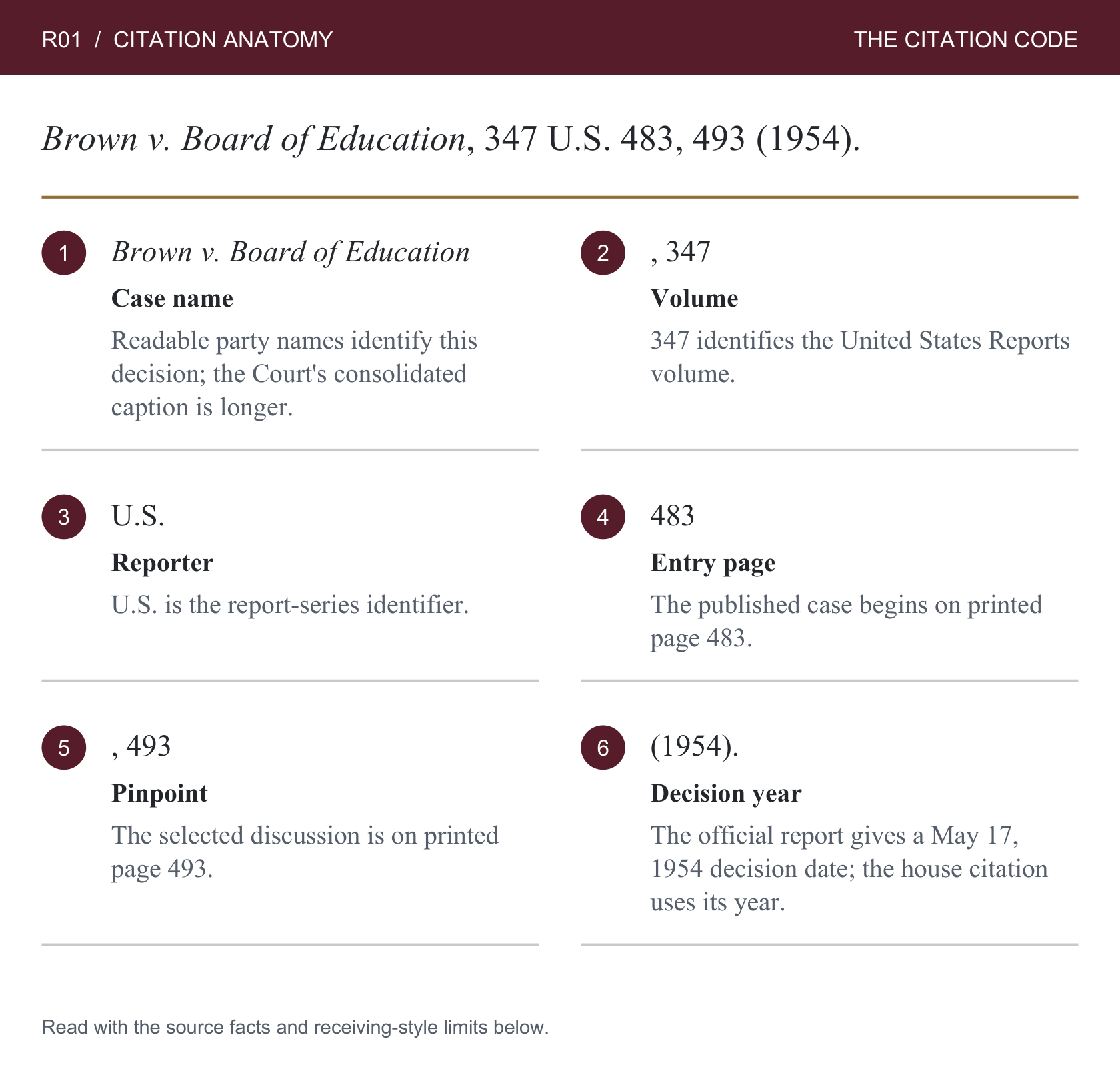
Source packet. The official report opens at 347 U.S. 483. Printed page 486 identifies Chief Justice Warren as delivering the opinion of the Court. Printed page 493 contains the discussion of education's public importance and the availability of a state-provided educational opportunity. In this individual PDF, that passage is on the eleventh PDF page.
| Label | Citation component | Function |
|---|---|---|
| 1. Case name | Brown v. Board of Education | Readable party names identify this decision; the Court's consolidated caption is longer. |
| 2. Volume | , 347 | 347 identifies the United States Reports volume. |
| 3. Reporter | U.S. | U.S. is the report-series identifier. |
| 4. Entry page | 483 | The published case begins on printed page 483. |
| 5. Pinpoint | , 493 | The selected discussion is on printed page 493. |
| 6. Decision year | (1954). | The official report gives a May 17, 1954 decision date; the house citation uses its year. |
The two page numbers perform different jobs. The entry page retrieves the case; the pinpoint retrieves the passage. Replacing 483 with 493 would obscure the published entry point, while omitting 493 would leave the reader searching the opinion. The passage was checked in the opinion itself, after the syllabus and appearances of counsel. A syllabus can guide navigation, but its page-reference list is not the location of the Court's words. Use this diagram to practice returning from a finished citation to the exact paragraph in the authoritative document.
Punctuation and type. Case-name italics, compressed reporter spacing, the comma before the pinpoint, and the year-only parenthesis are house presentation choices. The official volume, page numbers, and year are source facts. A final period closes this standalone citation sentence.
Where the locator leads. 493 is the number printed on the opinion page. The viewer's eleventh-page counter describes the file, and is retained only in the research record.
Receiving-style check. Follow the receiving court or journal's name, typeface, and reporter requirements; this atlas does not establish a universal abbreviation rule.
Variation. For a reference to the decision as a whole, omit the pinpoint: Brown v. Board of Education, 347 U.S. 483 (1954). Retain the pinpoint when the surrounding sentence relies on the selected discussion.
Inspection and limits. Printed pages 483, 486, and 493; PDF indices 0, 3, and 10. Official caption, report coordinates, author-role label, and selected page checked October 8, 2026. No later-treatment search or application to a present dispute was performed.
Official sources, checked October 8, 2026: Brown v. Board of Education, 347 U.S. 483 (1954).
R02 — A plurality passage needs its own attribution
Completed citation: Yates v. United States, 574 U.S. 528, 536 (2015) (Ginsburg, J., plurality opinion).
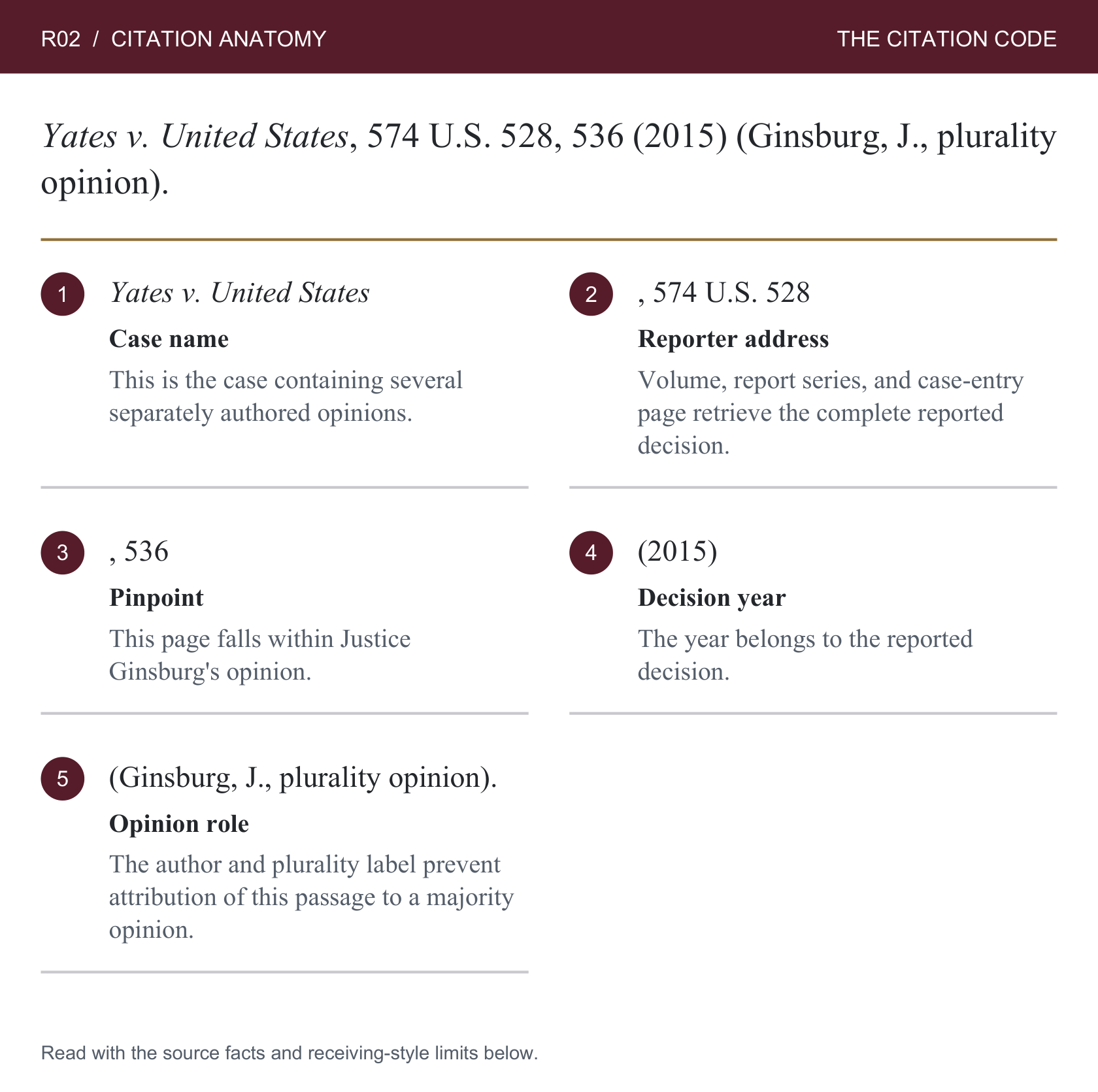
Source packet. The report's participation statement identifies Ginsburg's opinion as joined by Roberts, Breyer, and Sotomayor. Alito wrote separately while concurring in the judgment. At printed page 536, the Ginsburg opinion discusses the statutory setting and explains its reading of tangible object. The body heading identifies the writing as Ginsburg's opinion.
| Label | Citation component | Function |
|---|---|---|
| 1. Case name | Yates v. United States | This is the case containing several separately authored opinions. |
| 2. Reporter address | , 574 U.S. 528 | Volume, report series, and case-entry page retrieve the complete reported decision. |
| 3. Pinpoint | , 536 | This page falls within Justice Ginsburg's opinion. |
| 4. Decision year | (2015) | The year belongs to the reported decision. |
| 5. Opinion role | (Ginsburg, J., plurality opinion). | The author and plurality label prevent attribution of this passage to a majority opinion. |
Counting a judgment's supporting votes and counting the justices joining a particular explanation are separate tasks. This example makes the narrower attribution visible in the citation. It does not decide which formulation supplies a controlling rule under an applicable doctrine for fractured decisions. A drafter discussing page 536 should preserve the distinction even if a later source summarizes the case using the phrase the Court held. Read the vote statement and the selected opinion together before choosing the explanatory parenthesis.
Punctuation and type. The parenthesis after the year is an attribution supplied by Citation Code, grounded in the opinion's authorship and join information. It is not text appended by the reporter to every citation. The judge abbreviation and comma placement are house style.
Where the locator leads. 536 is a printed report page, appearing at PDF index 8. It locates Ginsburg's reasoning, not Alito's separate concurrence or Kagan's dissent.
Receiving-style check. Some receiving styles prefer simply plurality opinion or a different author-label sequence. Preserve the accurate role even when changing its presentation.
Variation. If the proposition instead depends on Alito's reasoning, the pinpoint and opinion-role parenthesis must both change. R03 supplies that separate construction.
Inspection and limits. Printed pages 530–531 and 536; PDF indices 2, 3, and 8. Identity, participation statement, body authorship label, and page 536 checked. No analysis of controlling-opinion doctrine or later treatment is certified.
Official sources, checked October 8, 2026: Yates v. United States, 574 U.S. 528 (2015).
R03 — One printed page can contain two opinions
Completed citation: Yates v. United States, 574 U.S. 528, 549 (2015) (Alito, J., concurring in the judgment).
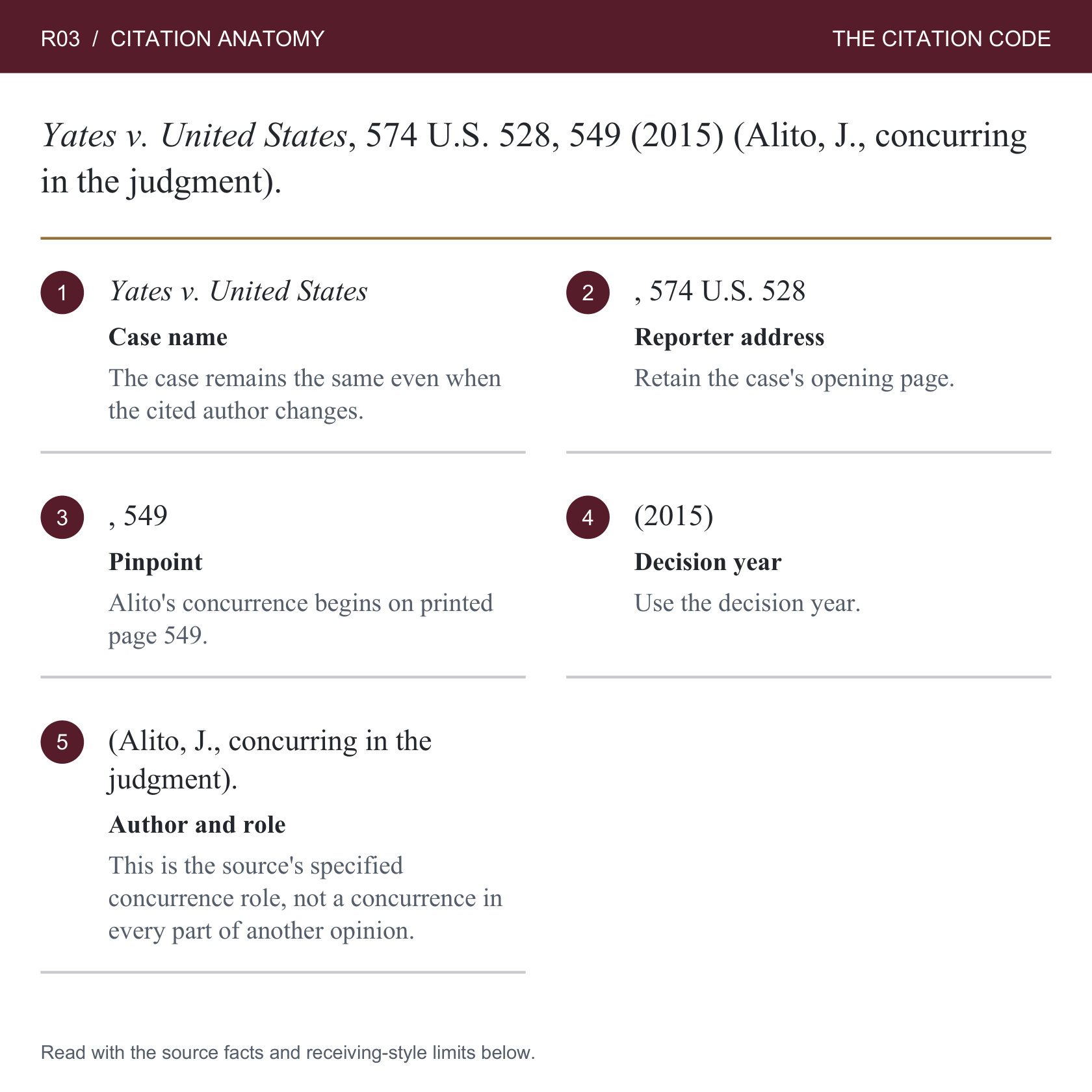
Source packet. Printed page 549 contains the closing lines of Ginsburg's opinion and the beginning of Alito's writing. The latter is expressly introduced as concurring in the judgment. Its opening paragraph identifies the statute's list of nouns, list of verbs, and title as features considered together.
| Label | Citation component | Function |
|---|---|---|
| 1. Case name | Yates v. United States | The case remains the same even when the cited author changes. |
| 2. Reporter address | , 574 U.S. 528 | Retain the case's opening page. |
| 3. Pinpoint | , 549 | Alito's concurrence begins on printed page 549. |
| 4. Decision year | (2015) | Use the decision year. |
| 5. Author and role | (Alito, J., concurring in the judgment). | This is the source's specified concurrence role, not a concurrence in every part of another opinion. |
A correct pinpoint can still be ambiguous when two writings share the same printed page. Here the author-role parenthesis disambiguates the intended passage. The running header names Alito, yet the first text on the page finishes the preceding opinion. A reader who treats the running header as the author of every line would misattribute part of the page. Inspect the transition heading in the body and read on both sides of it. This is a recurring problem in bound reports, where new opinions need not start on a fresh leaf.
Punctuation and type. The citation retains the ordinary case/report/year structure, then adds the role. Citation Code spells out concurring in the judgment because the source uses that more specific relationship. That wording communicates meaning; typeface and punctuation remain adaptable.
Where the locator leads. 549 retrieves a shared page. The body heading Justice Alito, concurring in the judgment identifies the beginning of the relevant writing; a quotation must be checked below that heading.
Receiving-style check. Do not shorten the role in a way that suggests Alito joined all of Ginsburg's reasoning. The receiving style controls the presentation of judicial titles and abbreviations.
Variation. For a quotation from the preceding opinion's final paragraph on the same page, retain 549 but change the author/role attribution. The page alone cannot perform that work.
Inspection and limits. Printed page 549; PDF index 21, body transition and concurrence opening. The transition between opinions, Alito's role, and the opening paragraph on 549 were inspected. No conclusion about current precedential force is supplied.
Official sources, checked October 8, 2026: Yates v. United States, 574 U.S. 528 (2015).
R04 — A dissent is a source with a different role
Completed citation: Yates v. United States, 574 U.S. 528, 553 (2015) (Kagan, J., dissenting).
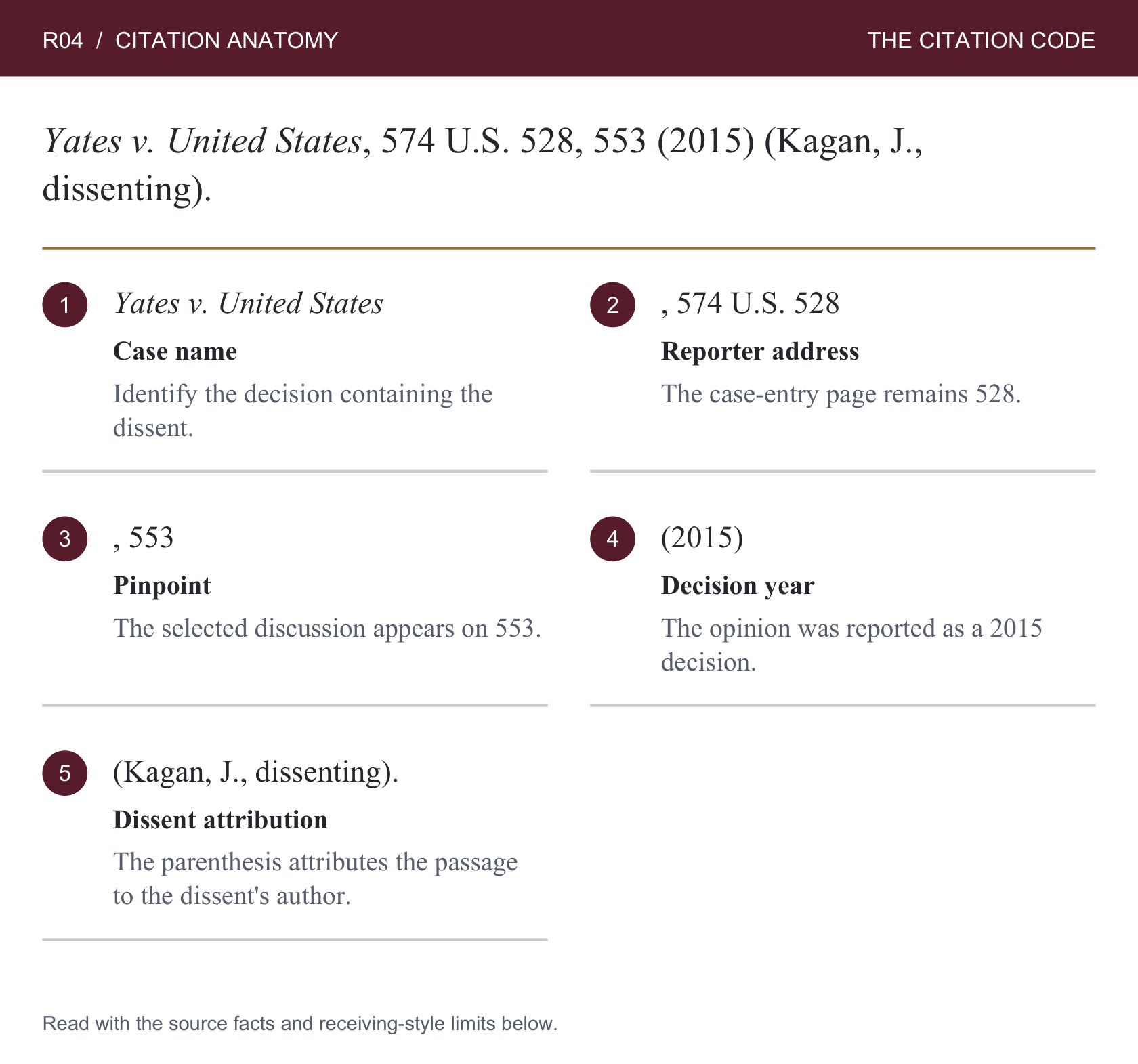
Source packet. Kagan's dissent begins on printed page 552; the report identifies Scalia, Kennedy, and Thomas as joining it. Page 553 continues her discussion of the ordinary meaning of tangible object. The page's body text and running header identify the dissent.
| Label | Citation component | Function |
|---|---|---|
| 1. Case name | Yates v. United States | Identify the decision containing the dissent. |
| 2. Reporter address | , 574 U.S. 528 | The case-entry page remains 528. |
| 3. Pinpoint | , 553 | The selected discussion appears on 553. |
| 4. Decision year | (2015) | The opinion was reported as a 2015 decision. |
| 5. Dissent attribution | (Kagan, J., dissenting). | The parenthesis attributes the passage to the dissent's author. |
A citation can accurately support the statement that a dissent made an argument without supporting the statement that the court adopted that argument. The surrounding sentence must make the same distinction as the parenthesis. For example, introduce the passage as Kagan's dissenting interpretation before giving the citation. Reusing this citation after an unqualified claim about what the Court required would change the apparent proposition without changing a single citation character. Verification therefore includes reading the proposition, the chosen passage, and the author-role label together.
Punctuation and type. Use a separate parenthesis for dissenting status after the date parenthesis. The selected house form italicizes the case name and keeps the role in ordinary type. The judicial title is an editorial abbreviation; the dissenting role comes from the report.
Where the locator leads. The pinpoint is 553 rather than the dissent's starting page 552 because the chosen discussion continues on the next page. A separate opinion's starting page does not replace the case's entry page 528.
Receiving-style check. Adapt typographic and author-name conventions to the recipient, while keeping the dissent attribution visible.
Variation. If discussing the dissent as a whole, a receiving style may permit its opening page. A quotation from the inspected continuation still belongs at 553.
Inspection and limits. Printed pages 530, 552, and 553; PDF indices 2, 24, and 25. The dissent's beginning, join statement, and page 553 discussion were checked. The citation does not certify adoption of the dissent, subsequent treatment, or its usefulness in a present matter.
Official sources, checked October 8, 2026: Yates v. United States, 574 U.S. 528 (2015).
R05 — A neutral identifier and a numbered paragraph
Completed citation: State v. Taylor, 2024-Ohio-1752, ¶ 4 (Ohio 2024).
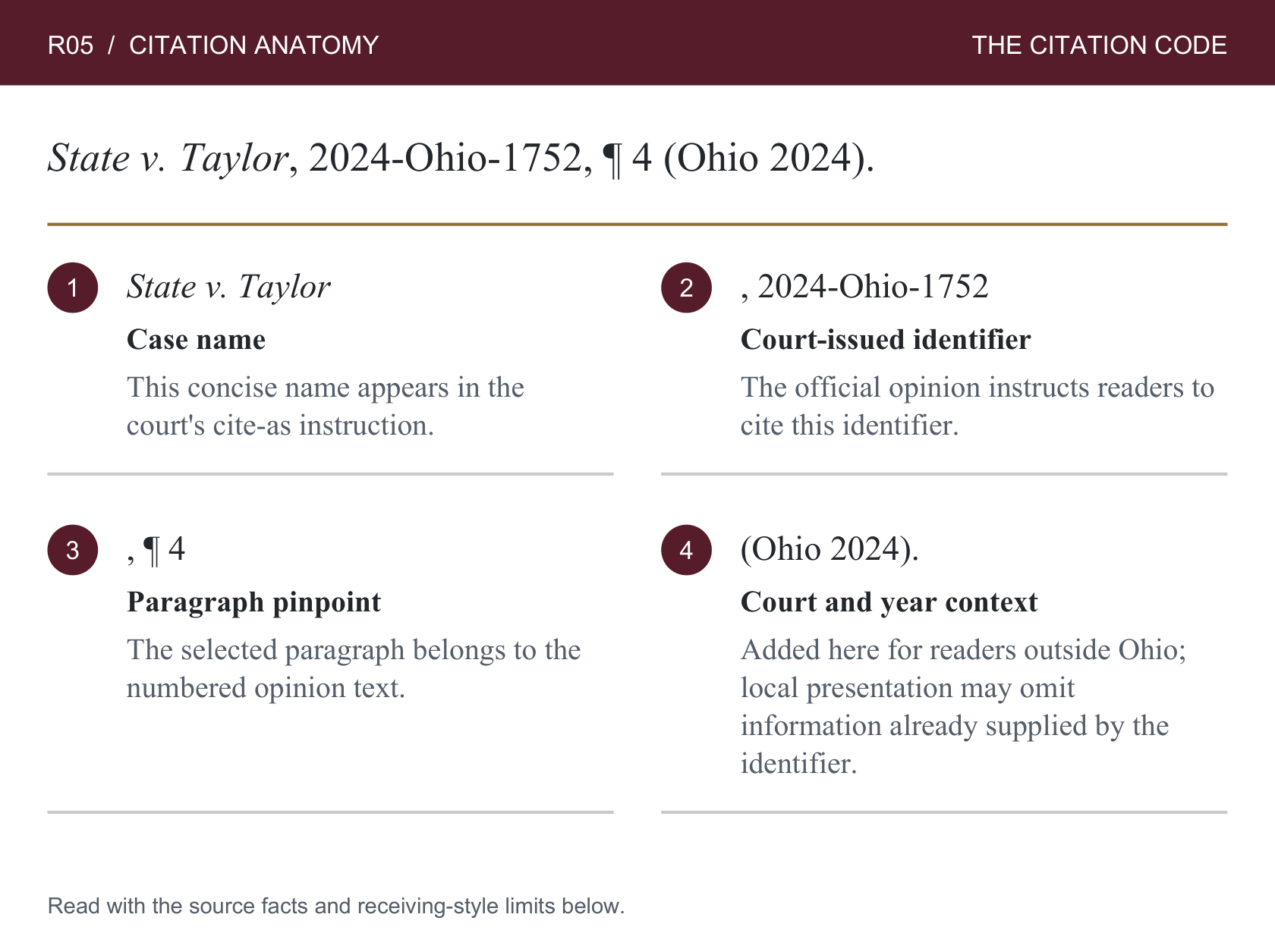
Source packet. The court's PDF supplies the cite-as line State v. Taylor, 2024-Ohio-1752 and a notice of publication at 176 Ohio St.3d 488. It gives docket 2022-1069 and a May 9, 2024 decision date. Paragraph 4, in Part I, begins the factual history on printed page 2.
| Label | Citation component | Function |
|---|---|---|
| 1. Case name | State v. Taylor | This concise name appears in the court's cite-as instruction. |
| 2. Court-issued identifier | , 2024-Ohio-1752 | The official opinion instructs readers to cite this identifier. |
| 3. Paragraph pinpoint | , ¶ 4 | The selected paragraph belongs to the numbered opinion text. |
| 4. Court and year context | (Ohio 2024). | Added here for readers outside Ohio; local presentation may omit information already supplied by the identifier. |
The identifier is neither the docket number nor a page reference. Its final number remains 1752 when a writer changes the pinpoint. Paragraph 4 is a stable coordinate assigned to the opinion's text, whereas the PDF's second-page position depends on the file. A further attribution check matters here: the opening identifies Stewart as writing for the court in Parts I and II(B), and announcing the judgment in Parts II(A) and III. Our selected factual paragraph lies in Part I. Do not carry that part-specific authorship conclusion to an uninspected paragraph elsewhere.
Punctuation and type. The hyphens inside 2024-Ohio-1752 belong to the identifier. The comma, paragraph symbol, spaces, and contextual parenthesis are this atlas's presentation. The official cite-as instruction supports the neutral identity, not every optional element added here.
Where the locator leads. ¶ 4 points to the paragraph beginning the factual account, not to printed page 4. The source packet separately records its printed-page and PDF positions.
Receiving-style check. An Ohio filing may call for a different arrangement, additional reporter information, or omission of the contextual parenthesis. Confirm the receiving requirements before filing.
Variation. Keep 2024-Ohio-1752 unchanged when selecting another paragraph. Reinspect the new paragraph's opinion part and authorship before transferring an attribution.
Inspection and limits. PDF first page for citation/date/roles; paragraph 4 on printed page 2, PDF index 1. Official identity, publication notice, role allocation, and paragraph 4 checked. No complete current-treatment review, litigation-status review, or statewide citation-rule claim is made.
Official sources, checked October 8, 2026: State v. Taylor, 2024-Ohio-1752.
R06 — Constitutional coordinates are structural
Completed citation: U.S. Const. art. III, § 2, cl. 1.
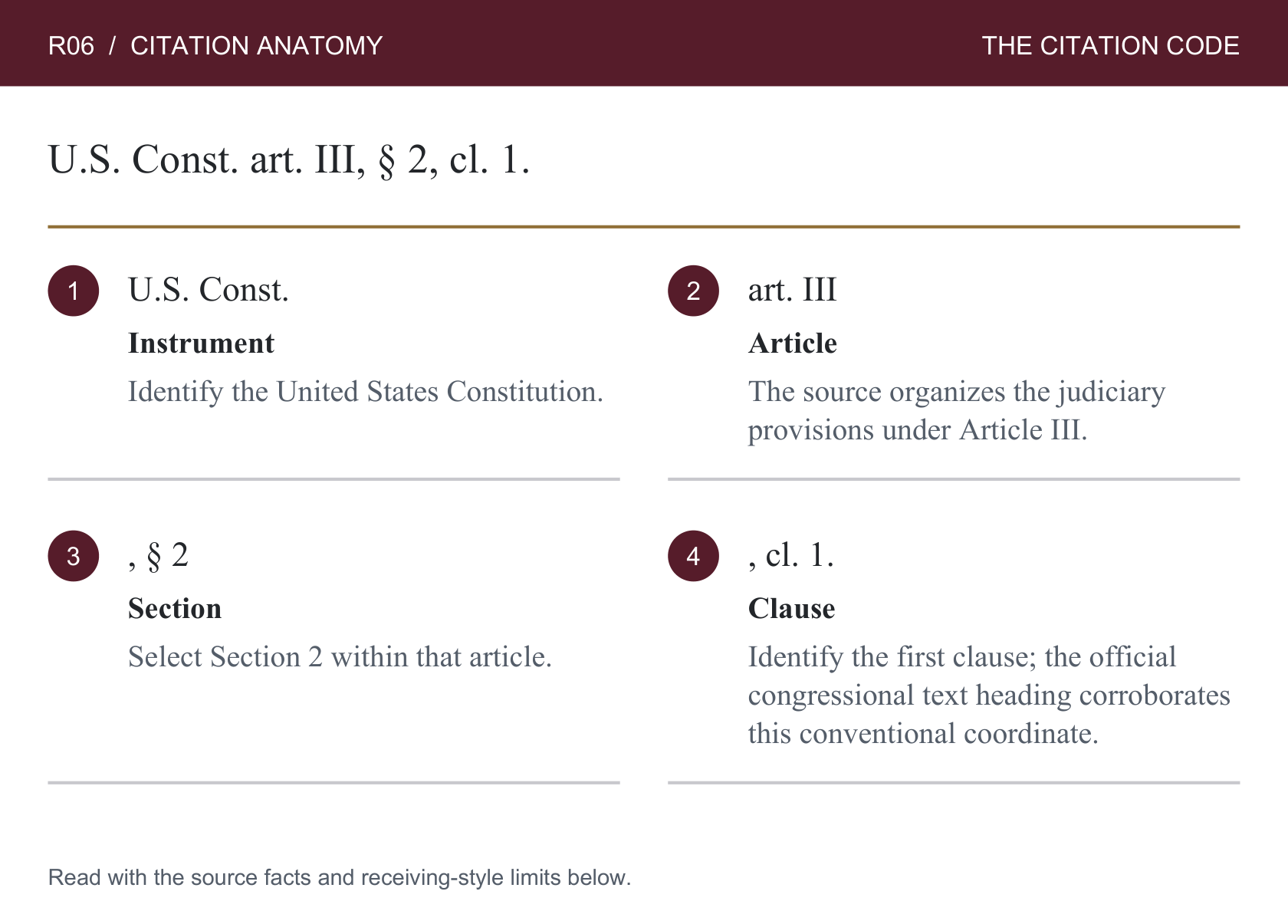
Source packet. The National Archives transcription places the judicial-power categories in the first paragraph of Article III, Section 2. A Constitution Annotated page reproduces the same constitutional text under the heading Article III, Section 2, Clause 1. Only that heading and constitutional text are used here, not the site's doctrinal essay.
| Label | Citation component | Function |
|---|---|---|
| 1. Instrument | U.S. Const. | Identify the United States Constitution. |
| 2. Article | art. III | The source organizes the judiciary provisions under Article III. |
| 3. Section | , § 2 | Select Section 2 within that article. |
| 4. Clause | , cl. 1. | Identify the first clause; the official congressional text heading corroborates this conventional coordinate. |
The source has a hierarchy rather than a reporter address. Article III locates the article, Section 2 narrows the text, and clause 1 identifies the selected unit. The Constitution Annotated essay's own topic number is not a substitute constitutional locator: it organizes commentary about the clause. The Archives transcription also flags historical language affected by amendments. A citation to this original text should not be presented as a complete statement of contemporary jurisdiction without separately examining the relevant amendments, statutes, and decisions.
Punctuation and type. Roman III represents the article in this house form; Arabic 2 and 1 identify the lower levels. Const., art., and cl. are readability conventions. The section symbol is not a claim that the Archives printed a symbol before every section heading.
Where the locator leads. The locator reaches the judicial-power paragraph, not Article III as a whole and not the subsequent paragraph addressing original and appellate jurisdiction.
Receiving-style check. A receiving style may prescribe capitalization, small capitals, or a differently abbreviated constitutional title. Preserve the structural coordinates while adapting those choices.
Variation. For discussion of the whole section, omit cl. 1. For a proposition about a different clause, inspect and identify that clause instead of assuming all Section 2 paragraphs share the same coordinate.
Inspection and limits. National Archives: Article III / Section 2 / first paragraph; official congressional constitutional-text heading: Article III, Section 2, Clause 1. The constitutional transcription and official clause-label heading were checked. This example supplies no current jurisdictional test, doctrinal summary, or treatment analysis.
Official sources, checked October 8, 2026: Constitution of the United States: Article III, Section 2; Official clause-label corroboration.
R07 — A statutory paragraph depends on its lead-in
Completed citation: 28 U.S.C. § 1332(a)(1) (2024).
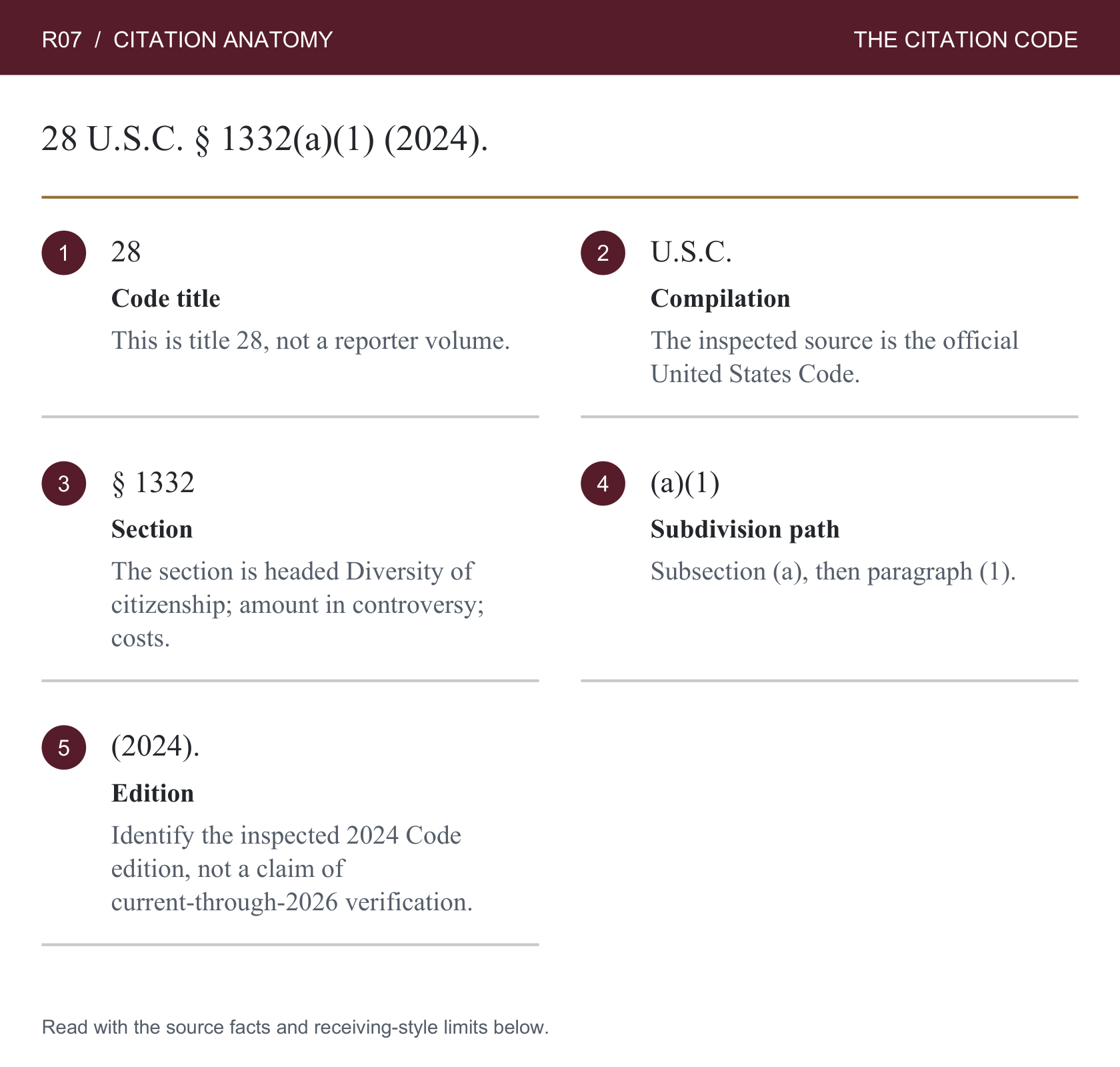
Source packet. GovInfo's 2024 edition places the amount-in-controversy wording in §1332(a)'s lead-in and the citizens-of-different-States category in paragraph (1). The header identifies title 28 and the 2024 edition. The section contains other paragraphs and substantial additional provisions.
| Label | Citation component | Function |
|---|---|---|
| 1. Code title | 28 | This is title 28, not a reporter volume. |
| 2. Compilation | U.S.C. | The inspected source is the official United States Code. |
| 3. Section | § 1332 | The section is headed Diversity of citizenship; amount in controversy; costs. |
| 4. Subdivision path | (a)(1) | Subsection (a), then paragraph (1). |
| 5. Edition | (2024). | Identify the inspected 2024 Code edition, not a claim of current-through-2026 verification. |
A narrow locator does not isolate a provision from the grammar above it. Paragraph (1) completes the lead-in; reading the words in that paragraph alone would omit qualifications carried by subsection (a). When explaining a citation, identify both the path and the text that gives the path meaning. This is also why moving from (a)(1) to (a) changes the scope of the reference. The citation identifies a historical edition that can be reopened; it does not establish that every later amendment, controlling interpretation, or jurisdictional prerequisite has been checked.
Punctuation and type. Place no spaces between the nested parenthetical subdivision markers. Use one section symbol for this one section. The terminal year identifies the edition selected in the source packet; it is not the date of enactment or the date of our research.
Where the locator leads. The path (a)(1) selects a citizenship category within subsection (a), whose opening language must be read with it.
Receiving-style check. Follow the recipient's rule for Code editions, supplements, currency dates, and year omission. Do not remove a useful historical-version qualifier from a historical analysis.
Variation. Use 28 U.S.C. § 1332(a) (2024) when deliberately discussing the complete subsection, and inspect all its alternatives before describing that larger unit.
Inspection and limits. Official HTML edition header; §1332(a) introductory text and (a)(1). Official 2024 header, subsection (a) lead-in, and paragraph (1) checked. No later amendment sweep or determination of federal jurisdiction for a real dispute was performed.
Official sources, checked October 8, 2026: 28 U.S.C. §1332, United States Code, 2024 Edition.
R08 — Do not invent a subsection to make a citation look precise
Completed citation: 42 U.S.C. § 1983 (2024).
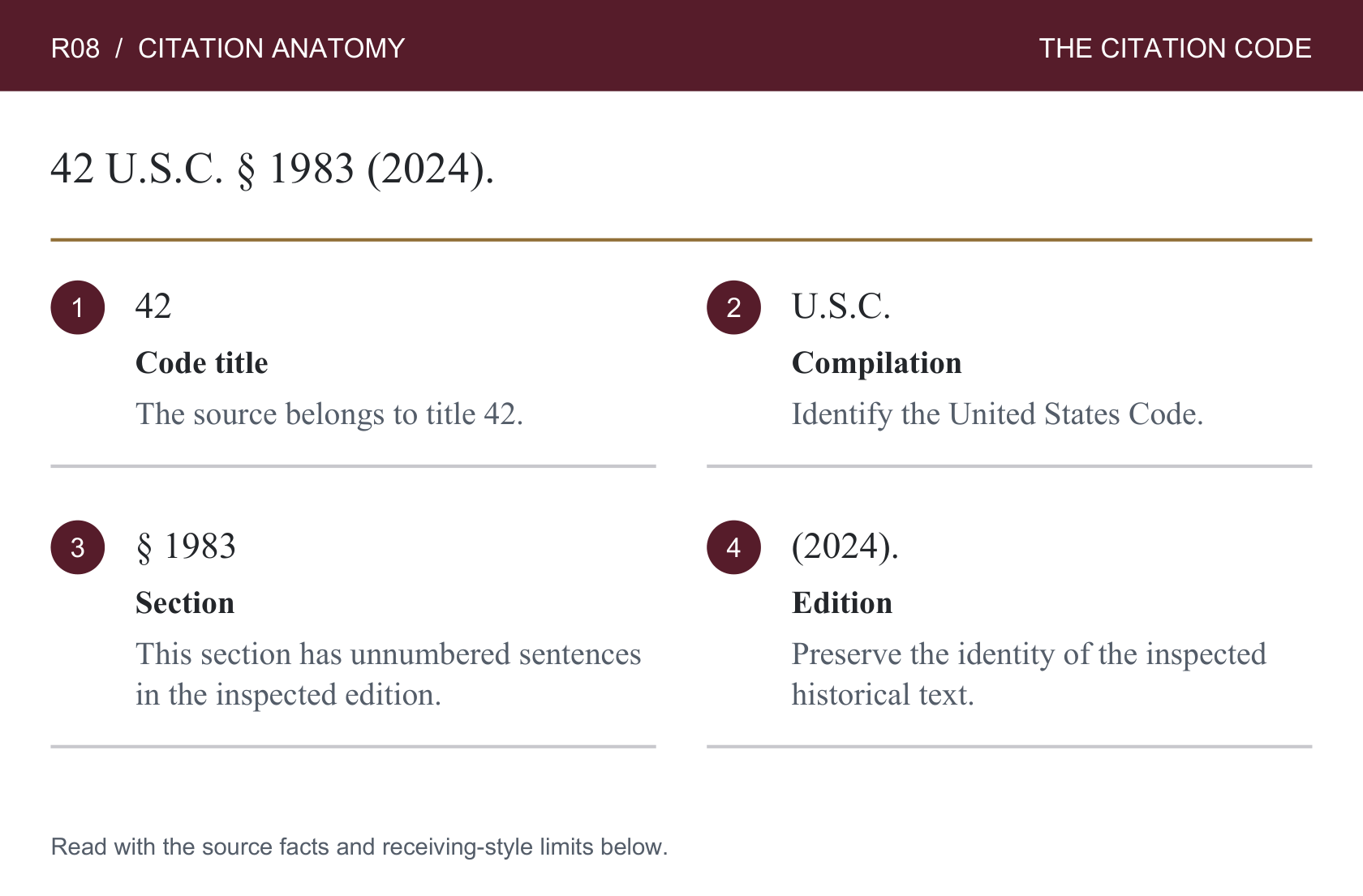
Source packet. The official 2024 text of §1983 consists of unnumbered sentences. The first contains a qualification concerning injunctive relief against a judicial officer. Source credits and editorial notes follow the operative text. No subsection (a) is displayed in this edition.
| Label | Citation component | Function |
|---|---|---|
| 1. Code title | 42 | The source belongs to title 42. |
| 2. Compilation | U.S.C. | Identify the United States Code. |
| 3. Section | § 1983 | This section has unnumbered sentences in the inspected edition. |
| 4. Edition | (2024). | Preserve the identity of the inspected historical text. |
Artificial precision is a retrieval defect. Appending (a) because a writer expects every statute to contain numbered subsections creates a coordinate that the inspected text does not supply. Cite the section and describe the relevant sentence or language in prose. A quotation may help narrow the discussion, provided its scope and surrounding qualification have been checked. Separate the operative text from the editorial history below it: both can be useful, but citing a historical note as if it were an additional subsection confuses their roles.
Punctuation and type. One section symbol and the section number provide the complete statutory coordinate here. There is no house-generated paragraph numbering. A descriptive reference such as the first sentence may appear in explanatory prose without pretending that the source labels it (a).
Where the locator leads. The citation retrieves all of §1983 in the stated edition. The source packet records that the selected language lies within its first, unnumbered sentence.
Receiving-style check. Some recipients permit a quotation or explanatory parenthesis to help identify unnumbered language. Use their convention without manufacturing statutory labels.
Variation. To discuss the section's historical derivation, identify the source or editorial note separately. Keep a note citation distinguishable from a citation to the statute's operative sentence.
Inspection and limits. Official HTML: §1983 body text above source credits and Editorial Notes. The 2024 edition header and complete displayed section text were checked, including the first sentence's qualification. No assessment of elements, immunities, remedies, or subsequent amendments is offered.
Official sources, checked October 8, 2026: 42 U.S.C. §1983, United States Code, 2024 Edition.
R09 — Session-law identity and the short-title provision
Completed citation: Laken Riley Act, Pub. L. No. 119-1, § 1, 139 Stat. 3 (2025).
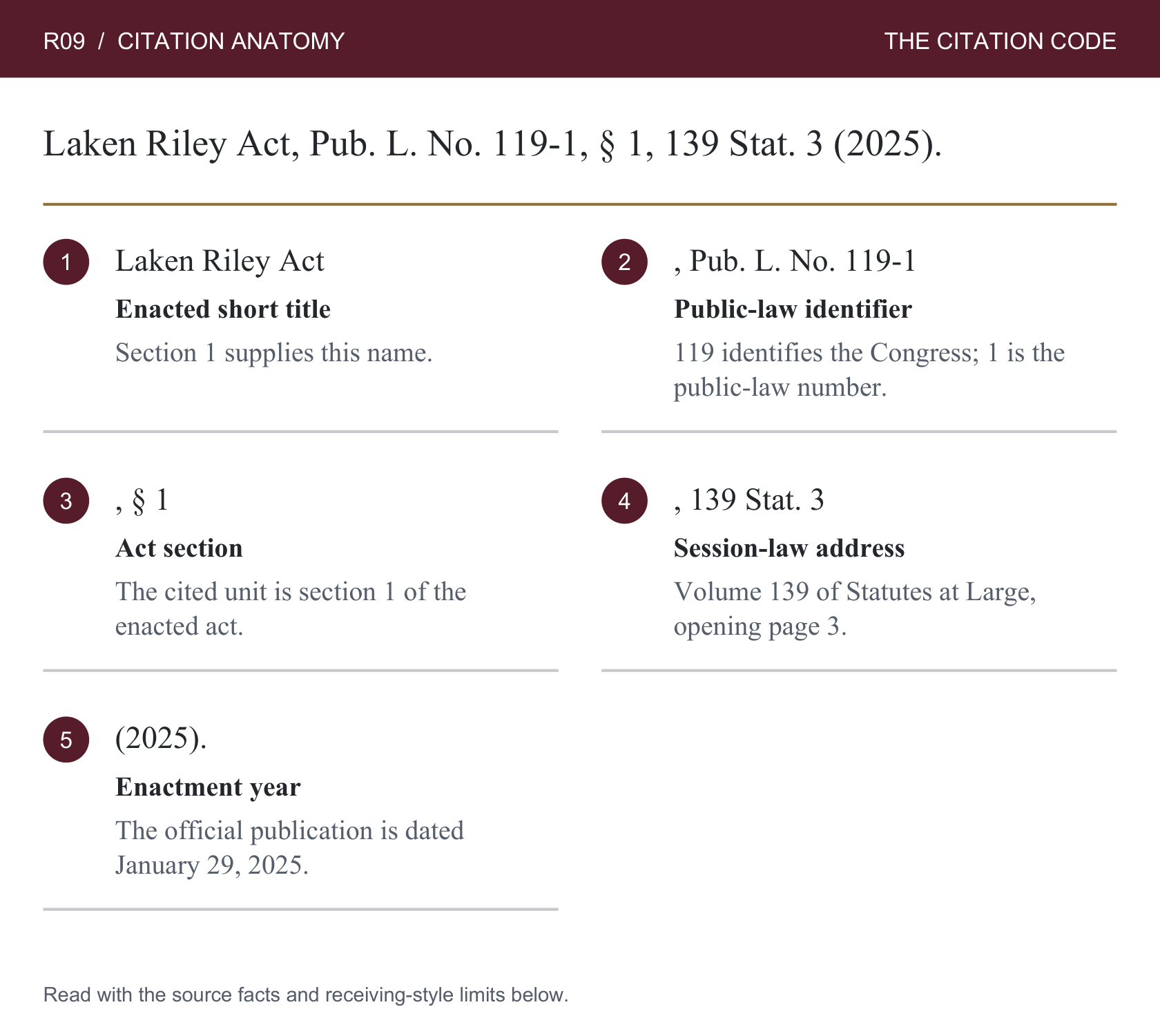
Source packet. The official public-law PDF identifies Public Law 119–1, January 29, 2025, and 139 Stat. 3. Section 1 appears on that same printed page and supplies the name Laken Riley Act. A bill number also appears in the legislative document set, but it is a different identifier.
| Label | Citation component | Function |
|---|---|---|
| 1. Enacted short title | Laken Riley Act | Section 1 supplies this name. |
| 2. Public-law identifier | , Pub. L. No. 119-1 | 119 identifies the Congress; 1 is the public-law number. |
| 3. Act section | , § 1 | The cited unit is section 1 of the enacted act. |
| 4. Session-law address | , 139 Stat. 3 | Volume 139 of Statutes at Large, opening page 3. |
| 5. Enactment year | (2025). | The official publication is dated January 29, 2025. |
The act section and Code section are not interchangeable. Here §1 identifies the short-title provision of an enacted act, not §1 of a U.S. Code title. The session-law address records the act as published at enactment. If the research question concerns currently codified operative language, locate that Code provision and its amendments separately. For this short-title example, using the enacted source makes the limited verification precise: it shows what this act calls itself without requiring a claim about how its substantive amendments currently operate.
Punctuation and type. The house form uses Pub. L. No. and Stat. and normalizes the public-law separator to a hyphen. The numbers come from the source. Because the chosen section appears on the act's opening page, no second identical 3 is needed in this house example.
Where the locator leads. §1 selects the short-title text on 139 Stat. 3. The PDF's first-page counter is a file coordinate, while 3 is the printed session-law page.
Receiving-style check. Receiving styles differ on act titles, public-law labels, and redundant pinpoint pages. Keep act sections distinct from codified sections when adapting the citation.
Variation. Compare R10's S. 5 calendar version. A bill that later becomes law must still be cited as a bill when that earlier wording or stage is the subject of discussion.
Inspection and limits. Section 1 on printed 139 Stat. 3; PDF index 0. The law number, enacted short title, date, and printed page were checked. No later amendment, current immigration-law rule, individual status, or enforcement consequence was analyzed.
Official sources, checked October 8, 2026: Laken Riley Act, Public Law 119–1.
R10 — The bill version is part of the source's identity
Completed citation: S. 5, 119th Cong. § 2 (placed on calendar Jan. 7, 2025).
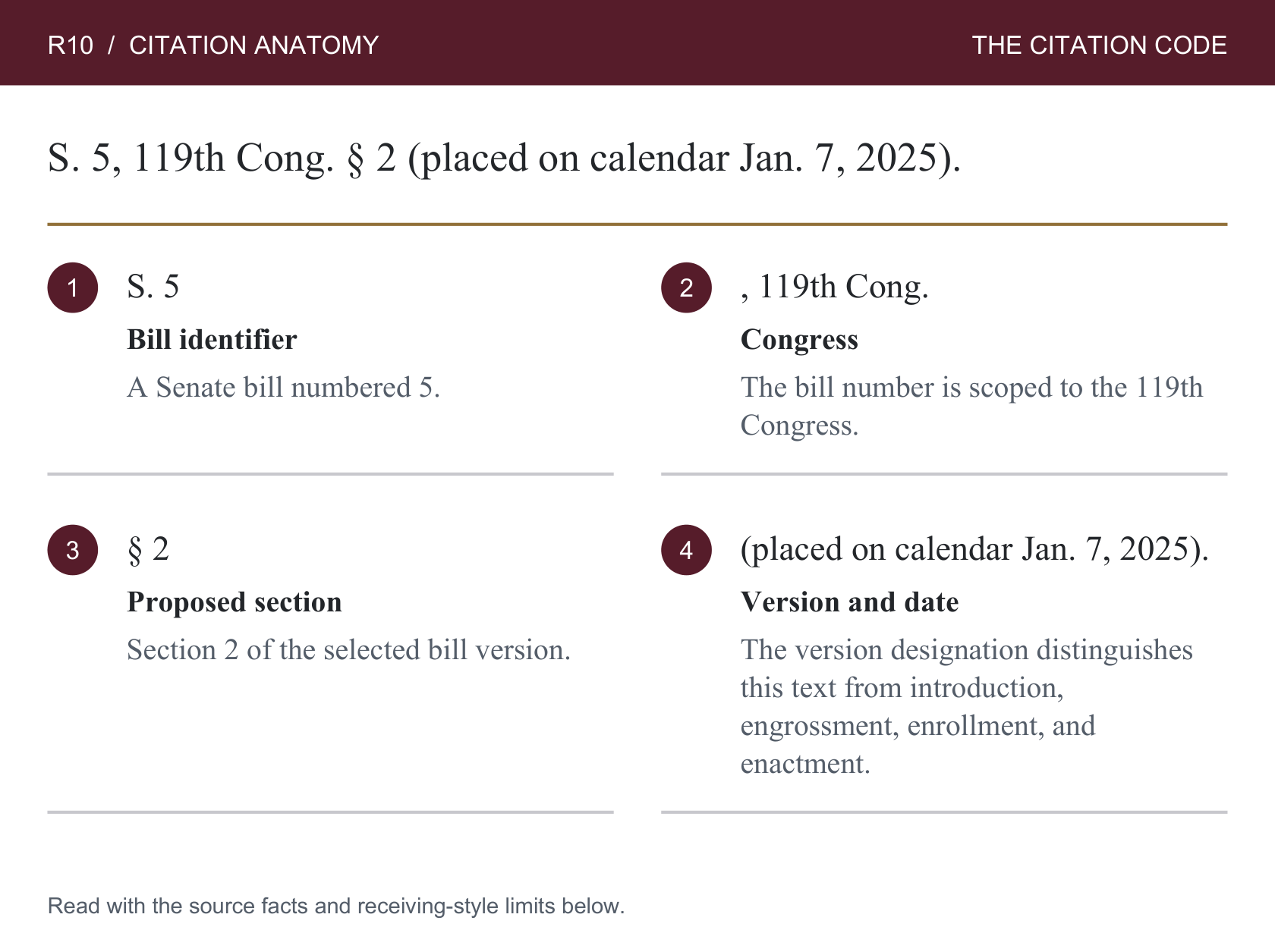
Source packet. The official PDF identifies S. 5 in the 119th Congress, first session. Its front page records introduction on January 6, 2025 and placement on the calendar on January 7. The next page begins with the short-title provision and section 2 heading. The footer uses the version code PCS.
| Label | Citation component | Function |
|---|---|---|
| 1. Bill identifier | S. 5 | A Senate bill numbered 5. |
| 2. Congress | , 119th Cong. | The bill number is scoped to the 119th Congress. |
| 3. Proposed section | § 2 | Section 2 of the selected bill version. |
| 4. Version and date | (placed on calendar Jan. 7, 2025). | The version designation distinguishes this text from introduction, engrossment, enrollment, and enactment. |
A bill number plus a Congress can still leave multiple texts in play. The version parenthesis names the one actually opened. For legislative-history work, this avoids silently substituting later enacted language for an earlier proposal. The two front-page dates also serve different purposes: the first marks introduction, while the second marks this calendar stage. Neither turns the bill into an enacted public law. The related session-law example in R09 illustrates why the title or subject alone cannot identify the document being cited.
Punctuation and type. The house parenthesis spells out the stage instead of leaving PCS unexplained. That stage is grounded in the official front-page statement. Keep §2 attached to the bill, and keep the date inside the version description so the reader knows what event it denotes.
Where the locator leads. The locator selects proposed section 2 in the January 7 calendar version, beginning on printed page 2. The page's line numbers are separate coordinates used only if a quotation requires them.
Receiving-style check. A recipient may prefer a session number, abbreviated version label, or publication year in addition to the stage. Retain enough information to retrieve the same text.
Variation. For an enactment proposition, return to Public Law 119–1 and inspect the enacted provision. Do not simply replace the bill's year while leaving its identifier unchanged.
Inspection and limits. PDF index 0 for Congress and stage dates; PDF index 1 for section 2 beginning. Official title page, dates, version footer, and section 2 heading checked. No line-by-line bill-to-law comparison or conclusion about legislative intent was performed.
Official sources, checked October 8, 2026: S. 5, 119th Congress, Placed on Calendar Senate version.
R11 — Follow the regulation across a page break
Completed citation: 28 C.F.R. § 35.130(b)(7)(i) (2024).
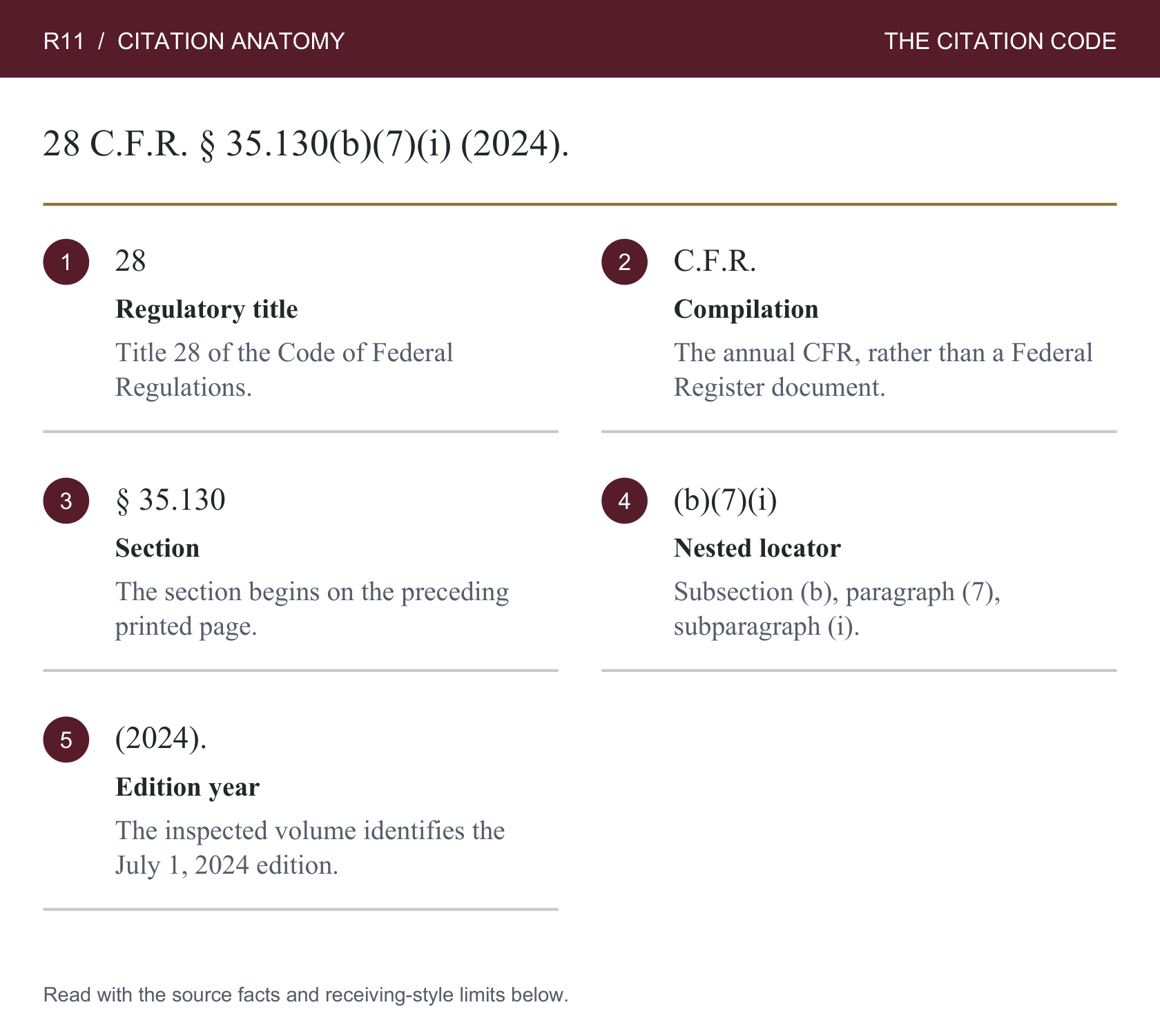
Source packet. The official annual CFR extract begins §35.130 on printed page 593. Section 35.130 continues on page 594, where paragraph (b)(7)(i) begins and includes the fundamental-alteration qualification. At the top of 594, the running header names §35.131, which begins only later on that page. The edition header states 7–1–24.
| Label | Citation component | Function |
|---|---|---|
| 1. Regulatory title | 28 | Title 28 of the Code of Federal Regulations. |
| 2. Compilation | C.F.R. | The annual CFR, rather than a Federal Register document. |
| 3. Section | § 35.130 | The section begins on the preceding printed page. |
| 4. Nested locator | (b)(7)(i) | Subsection (b), paragraph (7), subparagraph (i). |
| 5. Edition year | (2024). | The inspected volume identifies the July 1, 2024 edition. |
The nearest visible number is not necessarily the number governing the selected text. A reader who copies §35.131 from the top margin would move the citation to the next regulation. Trace the body hierarchy from the prior page, keeping subsection (b) active through its numbered paragraphs. Then read all of (7)(i), including the qualification at its end. The example uses an annual edition deliberately: its stable publication identity helps readers reproduce the exercise, while current practice requires a separate currency inquiry.
Punctuation and type. No spaces separate the nested parenthetical labels. The year describes this annual compilation; it is not the original promulgation year. Citation Code uses the structural regulatory locator instead of printed page 594 because the structure is more specific.
Where the locator leads. (b)(7)(i) identifies the subparagraph beginning on printed page 594. It does not reach the neighboring definition-related qualification in (b)(7)(ii) or the later §35.131 heading.
Receiving-style check. A receiving tribunal may require an annual edition, current eCFR date, or an amendment notice. Use the version it requires and verify that version directly.
Variation. For the neighboring subparagraph, change only the final marker to (ii) after reading it. A citation to (i) cannot automatically support a proposition drawn from (ii).
Inspection and limits. Printed pages 593–594, especially §35.130(b)(7)(i) on PDF index 1. The 2024 edition, continued hierarchy, full selected subparagraph, and next-section boundary were checked. No post-2024 amendments, current compliance obligations, or individual entitlement is certified.
Official sources, checked October 8, 2026: 28 C.F.R. §35.130, July 1, 2024 edition.
R12 — A final-rule publication has its own coordinates
Completed citation: Nondiscrimination on the Basis of Disability; Accessibility of Web Information and Services of State and Local Government Entities, 89 Fed. Reg. 31320 (Apr. 24, 2024) (final rule).
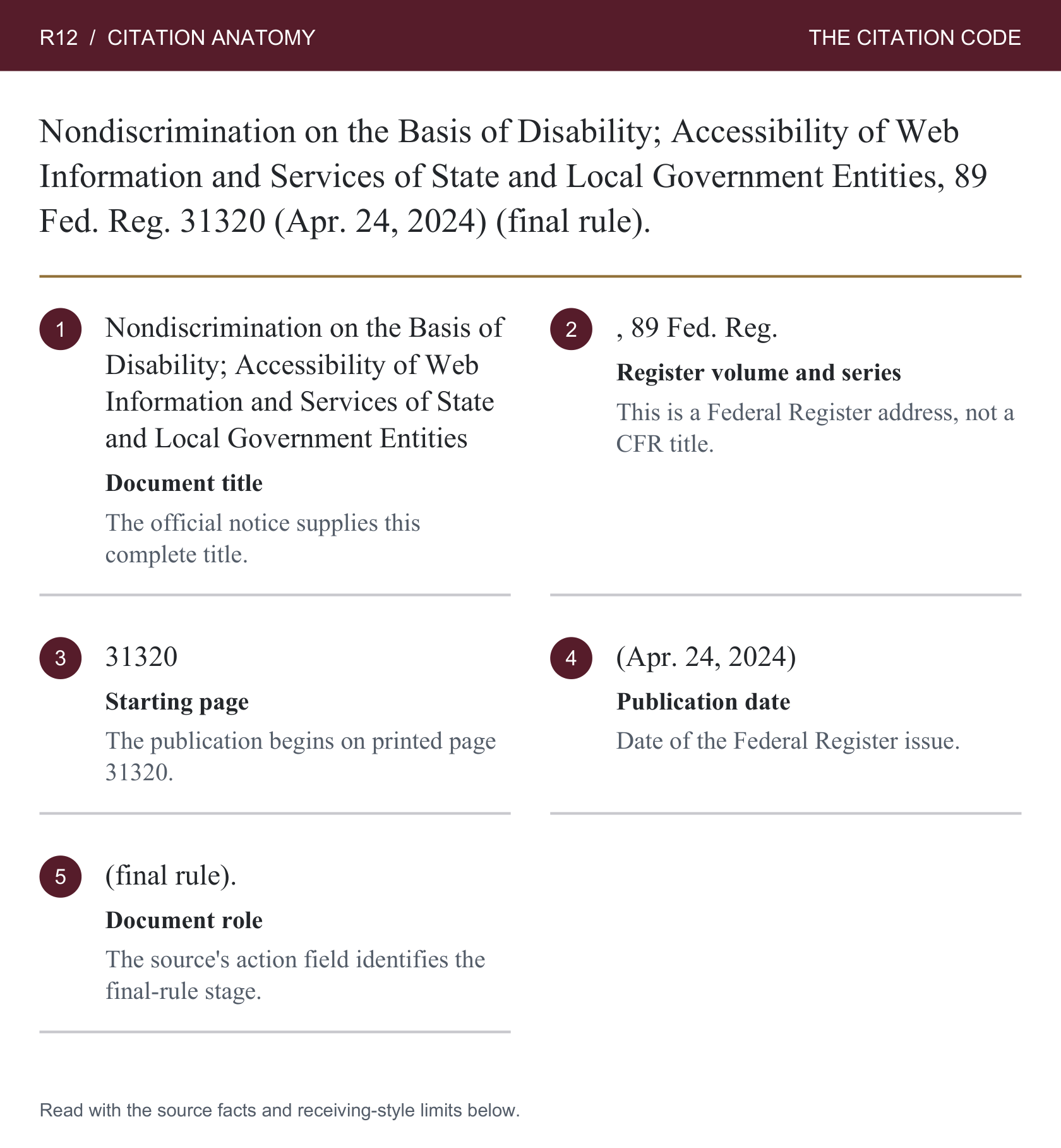
Source packet. The first official PDF page identifies the Department of Justice, Civil Rights Division, 28 CFR part 35, and the action Final rule. Its issue header reads volume 89, April 24, 2024, page 31320. The document includes separate summary, effective-date, and compliance-date fields.
| Label | Citation component | Function |
|---|---|---|
| 1. Document title | Nondiscrimination on the Basis of Disability; Accessibility of Web Information and Services of State and Local Government Entities | The official notice supplies this complete title. |
| 2. Register volume and series | , 89 Fed. Reg. | This is a Federal Register address, not a CFR title. |
| 3. Starting page | 31320 | The publication begins on printed page 31320. |
| 4. Publication date | (Apr. 24, 2024) | Date of the Federal Register issue. |
| 5. Document role | (final rule). | The source's action field identifies the final-rule stage. |
A Register citation identifies a published rulemaking document. It does not automatically cite the codified rule's latest text, nor does the date in parentheses automatically identify when every obligation began. Here the publication date is part of the document's address. Its separate date fields demonstrate why a writer must inspect the particular event before calling a date effective or applicable. The atlas uses only the first-page identity and stage to teach construction; it does not tell a public entity what deadline applies today.
Punctuation and type. The long title remains in ordinary type in this house form. The volume number and Fed. Reg. identify the series; the final-rule parenthesis makes the stage visible. Compact page digits are a house choice; receiving styles may insert a thousands separator.
Where the locator leads. 31320 is the beginning of this Register document and contains the inspected identification fields. A proposition drawn from a later preamble or regulatory-text page requires that later printed pinpoint.
Receiving-style check. Check whether the recipient prefers a rulemaking title, agency name, CFR destination, document number, or a particular date format.
Variation. Use a CFR citation for a proposition about a codified paragraph after inspecting the appropriate CFR version. Add this Register citation when the publication history or preamble is itself relevant.
Inspection and limits. Federal Register first printed page 31320; PDF index 0, title/action/date block. Official title, agency/action fields, volume, start page, and publication date checked. No current deadline, later amendment, judicial challenge, or compliance advice is supplied.
Official sources, checked October 8, 2026: Nondiscrimination on the Basis of Disability; Accessibility of Web Information and Services of State and Local Government Entities.
R13 — Matching titles can conceal different rulemaking stages
Completed citation: Nondiscrimination on the Basis of Disability; Accessibility of Web Information and Services of State and Local Government Entities, 88 Fed. Reg. 51948 (Aug. 4, 2023) (proposed rule).
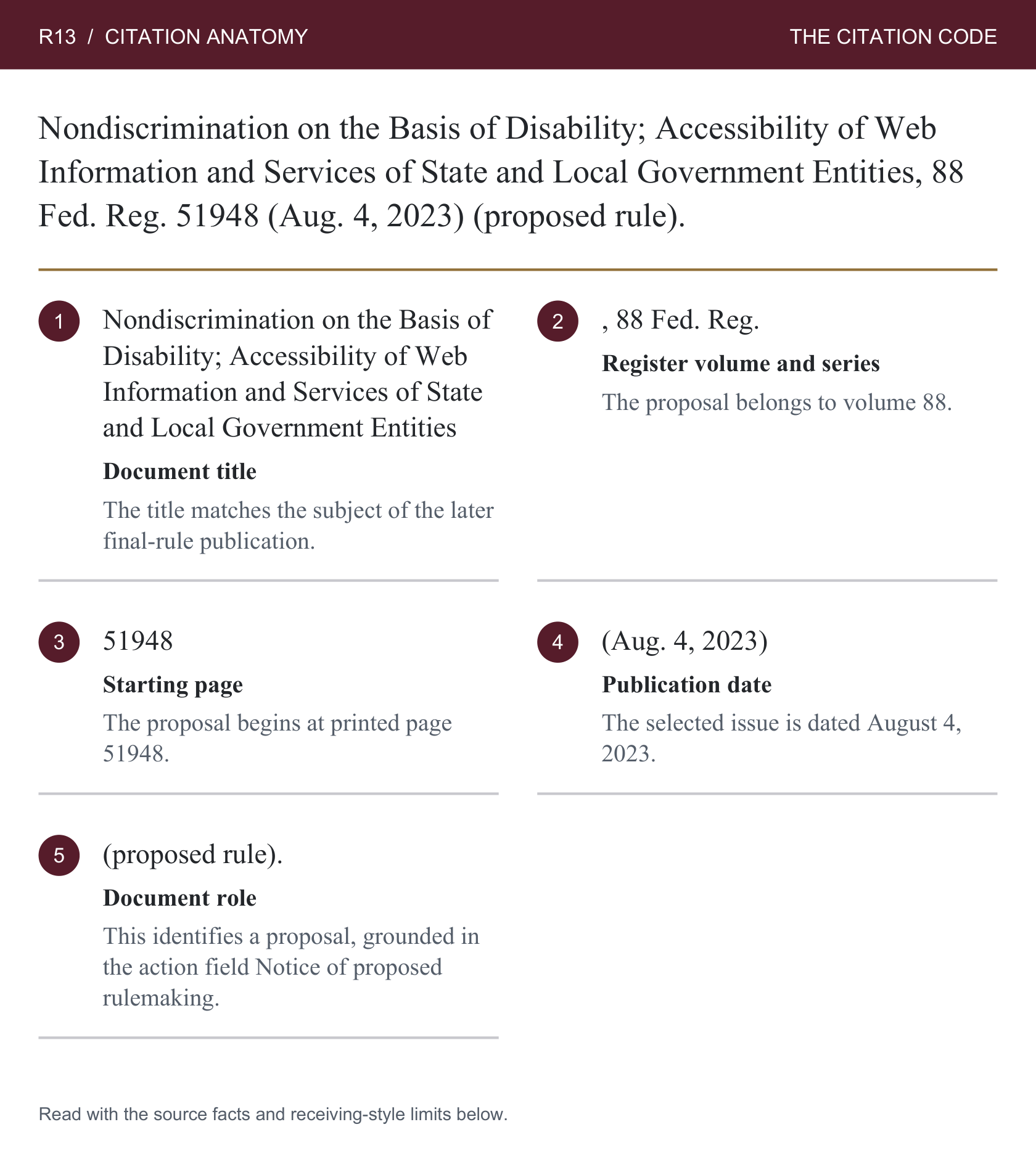
Source packet. The official PDF begins on page 51948 in the August 4, 2023 Federal Register. Its issue heading says Proposed Rules and its action field identifies a notice of proposed rulemaking. The Department of Justice and rulemaking title match the later publication in R12, but the volume, page, date, and stage differ.
| Label | Citation component | Function |
|---|---|---|
| 1. Document title | Nondiscrimination on the Basis of Disability; Accessibility of Web Information and Services of State and Local Government Entities | The title matches the subject of the later final-rule publication. |
| 2. Register volume and series | , 88 Fed. Reg. | The proposal belongs to volume 88. |
| 3. Starting page | 51948 | The proposal begins at printed page 51948. |
| 4. Publication date | (Aug. 4, 2023) | The selected issue is dated August 4, 2023. |
| 5. Document role | (proposed rule). | This identifies a proposal, grounded in the action field Notice of proposed rulemaking. |
Searching by title can return a convincing but wrong version. This pair of examples makes version identity part of citation verification: inspect the action field before describing the source's legal role. The proposal can support a statement about what the agency proposed or asked readers to address at that stage. Whether language survived into a later final regulation requires a comparison that this citation alone does not perform. Keeping a proposal label visible also helps an editor catch an accidental substitution during revision.
Punctuation and type. Proposed rule is a house-stage description reflecting the official action field, not a declaration that the proposal is currently pending. The source's historical publication date stays attached to this document even after later agency action.
Where the locator leads. 51948 retrieves the proposal's beginning and the identification fields actually checked. It does not pinpoint every proposed regulatory paragraph reproduced later in the document.
Receiving-style check. The recipient may prefer a date parenthesis beginning proposed, a separate action label, or an additional CFR destination. Preserve the proposal/final distinction through that formatting change.
Variation. Compare 88 Fed. Reg. 51948 with 89 Fed. Reg. 31320 in R12. Replacing only the date leaves the citation pointing to the earlier document.
Inspection and limits. Federal Register first printed page 51948; PDF index 0, issue heading and action field. The proposal's official identity, stage, and beginning page were checked. The atlas makes no claim that proposed wording became law or remains pending.
Official sources, checked October 8, 2026: Nondiscrimination on the Basis of Disability; Accessibility of Web Information and Services of State and Local Government Entities.
R14 — Cite a court rule by rule, and label the historical version
Completed citation: Sup. Ct. R. 33.1(b) (2023 text).
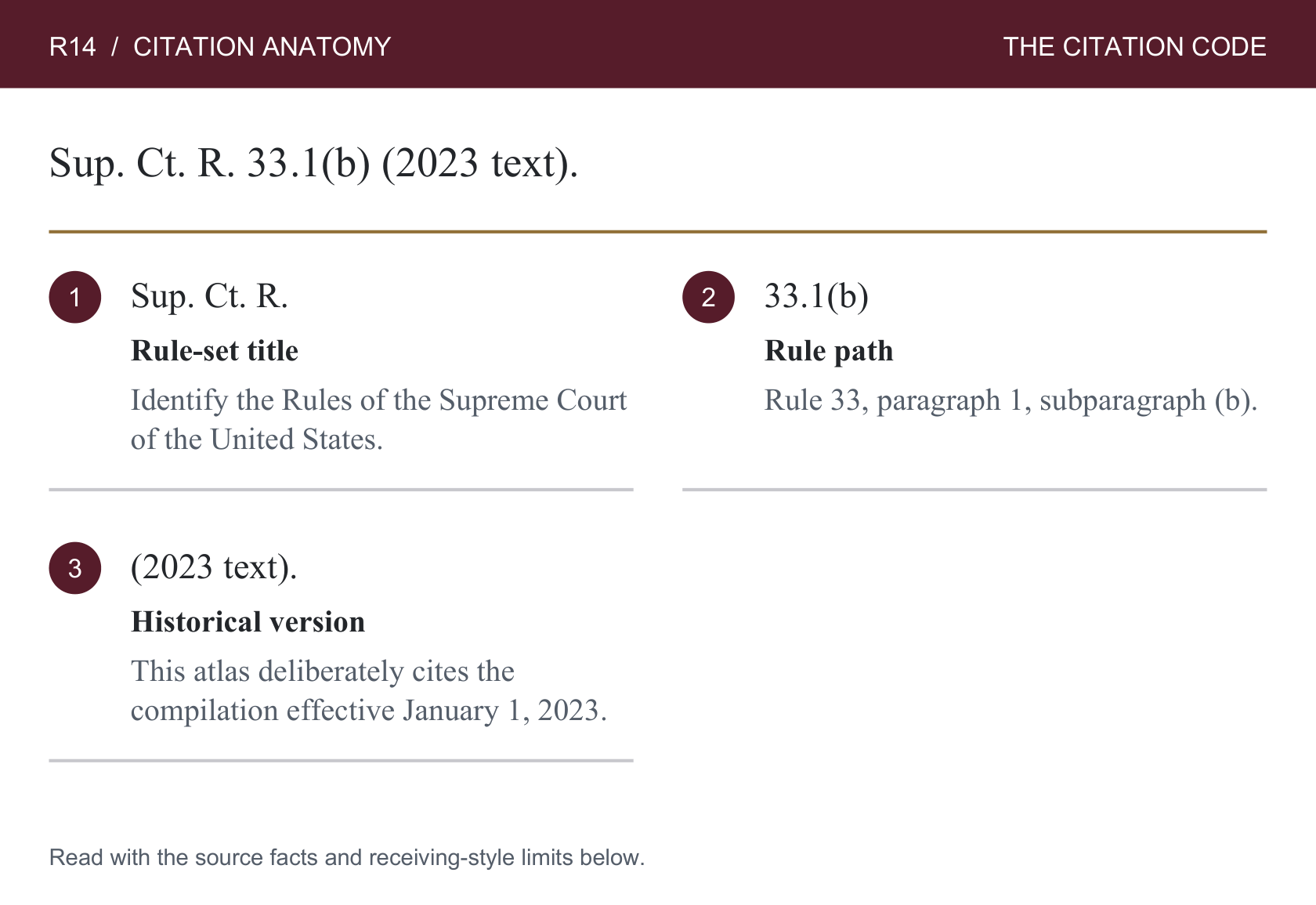
Source packet. The official 2023 rules title page states adoption on December 5, 2022 and effectiveness on January 1, 2023. On printed page 43, Rule 33.1(b) addresses typography for booklet-format documents. The Court also provides a historical-rules collection, making the edition boundary important.
| Label | Citation component | Function |
|---|---|---|
| 1. Rule-set title | Sup. Ct. R. | Identify the Rules of the Supreme Court of the United States. |
| 2. Rule path | 33.1(b) | Rule 33, paragraph 1, subparagraph (b). |
| 3. Historical version | (2023 text). | This atlas deliberately cites the compilation effective January 1, 2023. |
A citation to a filing rule is useful only if the reader can distinguish the rule's identity from the edition consulted. The historical qualifier here is intentionally visible. It allows the atlas to show a real provision without silently claiming that a 2023 compilation governs every filing made in 2026. The selected paragraph concerns typography; the full rule contains other production requirements. A proofreader answering a practical formatting question must inspect the currently applicable rule set, neighboring provisions, and any relevant orders, rather than extending this narrow example beyond its checked scope.
Punctuation and type. 33.1(b) is a rule hierarchy, not a decimal page number. The abbreviation and historical parenthesis are Citation Code presentation. The official page and body heading supply the rule identity; the cover supplies the compilation's effective date.
Where the locator leads. The structural pinpoint reaches the booklet-format typography paragraph on printed page 43, PDF index 46. The number 43 is useful for navigation but does not replace 33.1(b).
Receiving-style check. Use the recipient's preferred rule abbreviation and edition treatment. This example's 2023-text label must not be dropped in a way that implies a current-rule verification.
Variation. When checking today's filing, retrieve the current official rules first. Reuse the structural locator only after confirming that the current paragraph still supplies the relevant requirement.
Inspection and limits. Official 2023 compilation: title page; printed page 43, Rule 33.1(b), PDF index 46. Official 2023 title-page dates and Rule 33.1(b) text checked. No certificate of current Supreme Court filing compliance, exception analysis, or review of a particular document is provided.
Official sources, checked October 8, 2026: Rules of the Supreme Court of the United States, effective January 1, 2023; Official historical-version collection.
R15 — A rule appendix remains a rule source
Completed citation: Fed. R. Civ. P. 56(c)(1)(A) (2024 text).
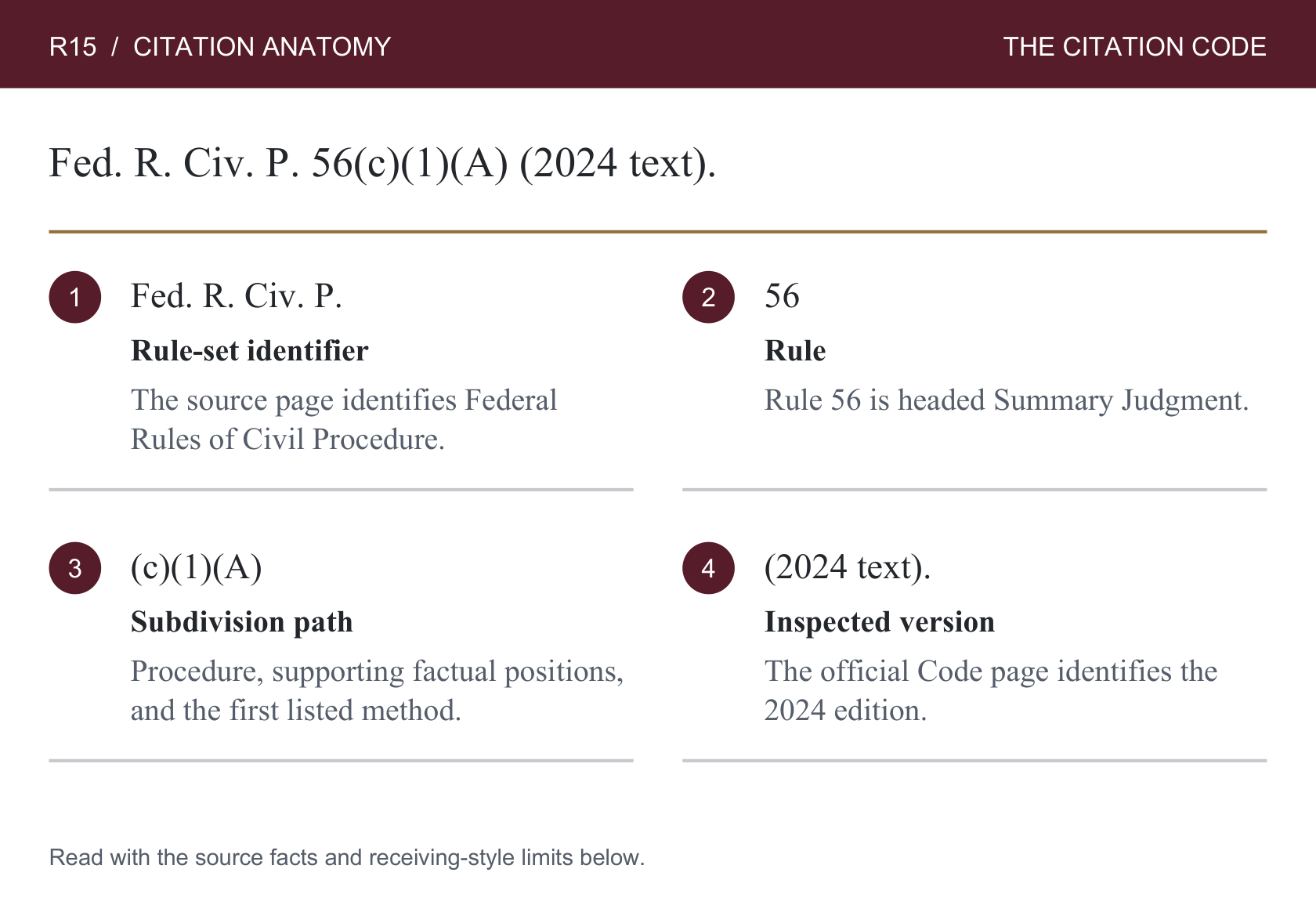
Source packet. GovInfo's 2024 United States Code appendix reproduces Rule 56. Paragraph (c)(1)(A) addresses citations to particular parts of record materials. The neighboring paragraph (B) supplies a separately labeled alternative. The page also includes advisory committee notes below the rule text.
| Label | Citation component | Function |
|---|---|---|
| 1. Rule-set identifier | Fed. R. Civ. P. | The source page identifies Federal Rules of Civil Procedure. |
| 2. Rule | 56 | Rule 56 is headed Summary Judgment. |
| 3. Subdivision path | (c)(1)(A) | Procedure, supporting factual positions, and the first listed method. |
| 4. Inspected version | (2024 text). | The official Code page identifies the 2024 edition. |
The host compilation does not erase the document's type. This example cites the Federal Rule of Civil Procedure rather than treating 56 as an ordinary section of title 28. The nested path matters because the paragraph is one method within a larger provision. If a sentence claims that this is the only permitted method, the nearby alternative must be considered before the sentence is finalized. Rule text and committee notes also play different roles: a proposition about the note's explanation needs a citation that identifies the note, not a silent substitution of the note for operative text.
Punctuation and type. No section symbol appears before a rule number in this house form. The lower-case c, numeral 1, and capital A reproduce the source's nested labels; preserving case prevents a hierarchy error. The historical qualifier identifies the inspected edition.
Where the locator leads. The locator reaches clause (A) under Rule 56(c)(1). The same page's advisory notes and paragraph (B) are outside that narrow target.
Receiving-style check. Adapt the rule-set abbreviation and historical-version notation to the recipient. A real filing also requires the applicable current text and local rules.
Variation. For a claim about both alternatives, cite Rule 56(c)(1) after reading them together. For the committee's explanation, identify the relevant advisory committee note and its year separately.
Inspection and limits. Official 2024 Code HTML: Rule 56(c), (c)(1), (c)(1)(A), and (c)(1)(B). The official 2024 header, rule title, selected text, and adjacent alternative were inspected. No current amendment sweep, record-sufficiency opinion, or summary-judgment outcome is represented.
Official sources, checked October 8, 2026: Federal Rule of Civil Procedure 56, United States Code, 2024 Edition.
R16 — Hearing date, printing date, and witness identity
Completed citation: Oversight of A.I.: Rules for Artificial Intelligence, S. Hrg. 118-037, at 6 (May 16, 2023 hearing; printed 2024) (statement of Samuel Altman).
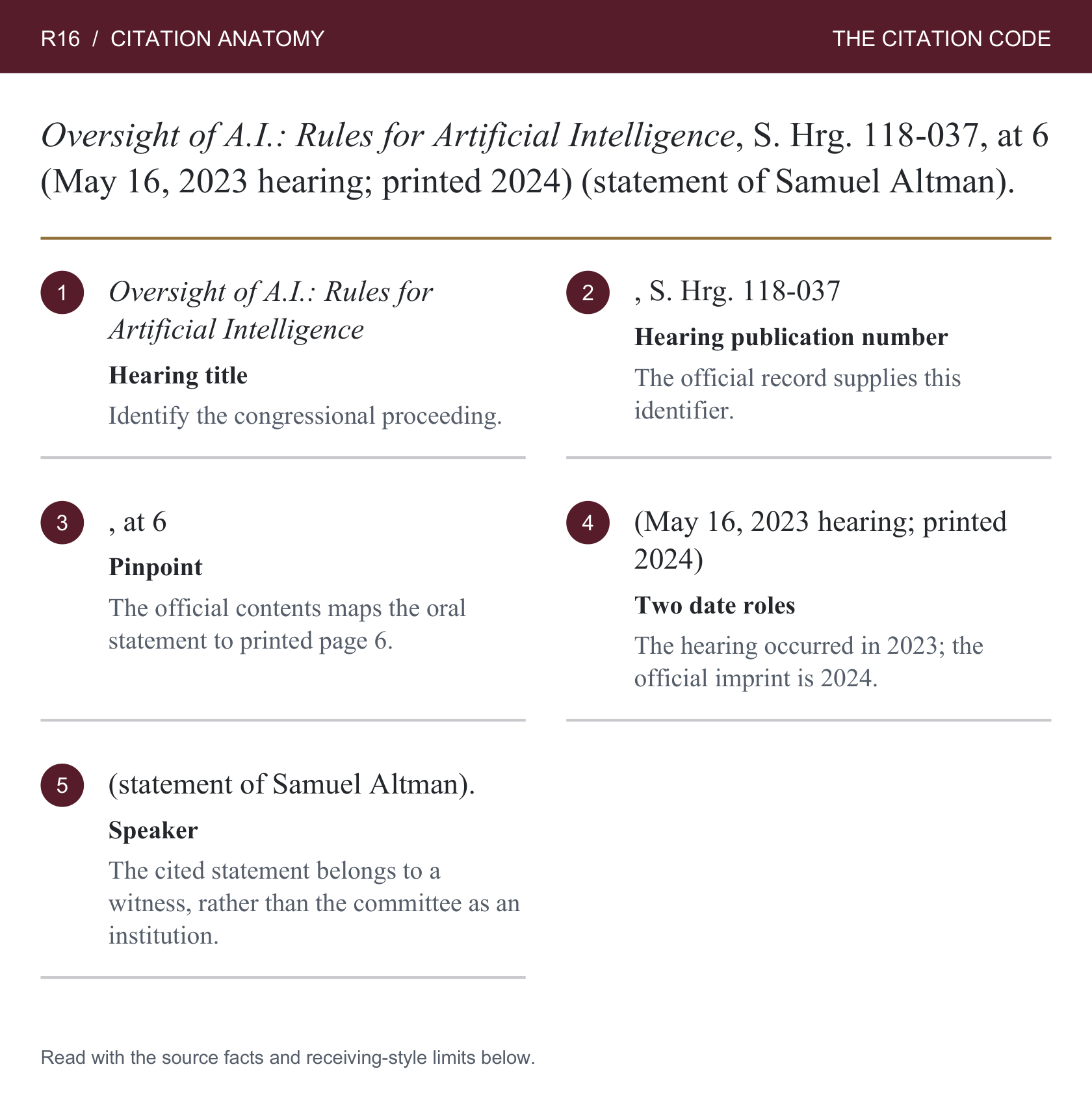
Source packet. The official GPO hearing record identifies the Senate Judiciary Subcommittee on Privacy, Technology, and the Law, the 118th Congress, and a May 16, 2023 hearing. Its imprint is Washington, 2024. The contents lists Samuel Altman's oral statement at page 6 and his prepared statement at page 58. The corresponding oral-statement body heading was inspected.
| Label | Citation component | Function |
|---|---|---|
| 1. Hearing title | Oversight of A.I.: Rules for Artificial Intelligence | Identify the congressional proceeding. |
| 2. Hearing publication number | , S. Hrg. 118-037 | The official record supplies this identifier. |
| 3. Pinpoint | , at 6 | The official contents maps the oral statement to printed page 6. |
| 4. Two date roles | (May 16, 2023 hearing; printed 2024) | The hearing occurred in 2023; the official imprint is 2024. |
| 5. Speaker | (statement of Samuel Altman). | The cited statement belongs to a witness, rather than the committee as an institution. |
An official transcript is primary evidence of the recorded testimony, not an enacted rule or a committee endorsement of every witness claim. Here the attribution matters as much as the locator. The oral and prepared statements are different source units even though they share a speaker. A quotation taken from a prepared submission should not inherit the oral statement's page reference. The explicit two-date parenthesis also prevents a misleading chronology: a 2024 printing does not move the hearing into 2024.
Punctuation and type. Citation Code italicizes the hearing title and retains the official publication number. Its explanatory date parenthesis is deliberately fuller than a compact filing citation. The speaker parenthesis identifies the person in the historical record; it is not a claim about anyone's current office.
Where the locator leads. The inspected official contents assigns page 6 to the oral statement. The matching body heading and opening text were checked in the official HTML; a PDF page image was not independently inspected.
Receiving-style check. A recipient may require the full committee name, Congress/session, or a different hearing-number form. Those facts are retained in the source packet for adaptation.
Variation. A citation to the prepared statement needs its own inspected passage and locator. The contents suggests page 58, but the prepared statement's substance was not reviewed for this example.
Inspection and limits. Official hearing HTML: title/imprint, contents entry for Samuel Altman, and corresponding oral-statement heading and opening text. Official title, committee, Congress, hearing date, printing year, contents mapping, and body heading checked. No word-for-word audio comparison or validation of the witness's substantive assertions was performed.
Official sources, checked October 8, 2026: Oversight of A.I.: Rules for Artificial Intelligence, S. Hrg. 118-037.
R17 — A report's Congress can differ from the period it describes
Completed citation: S. Rep. No. 119-10, at 27 (2025).
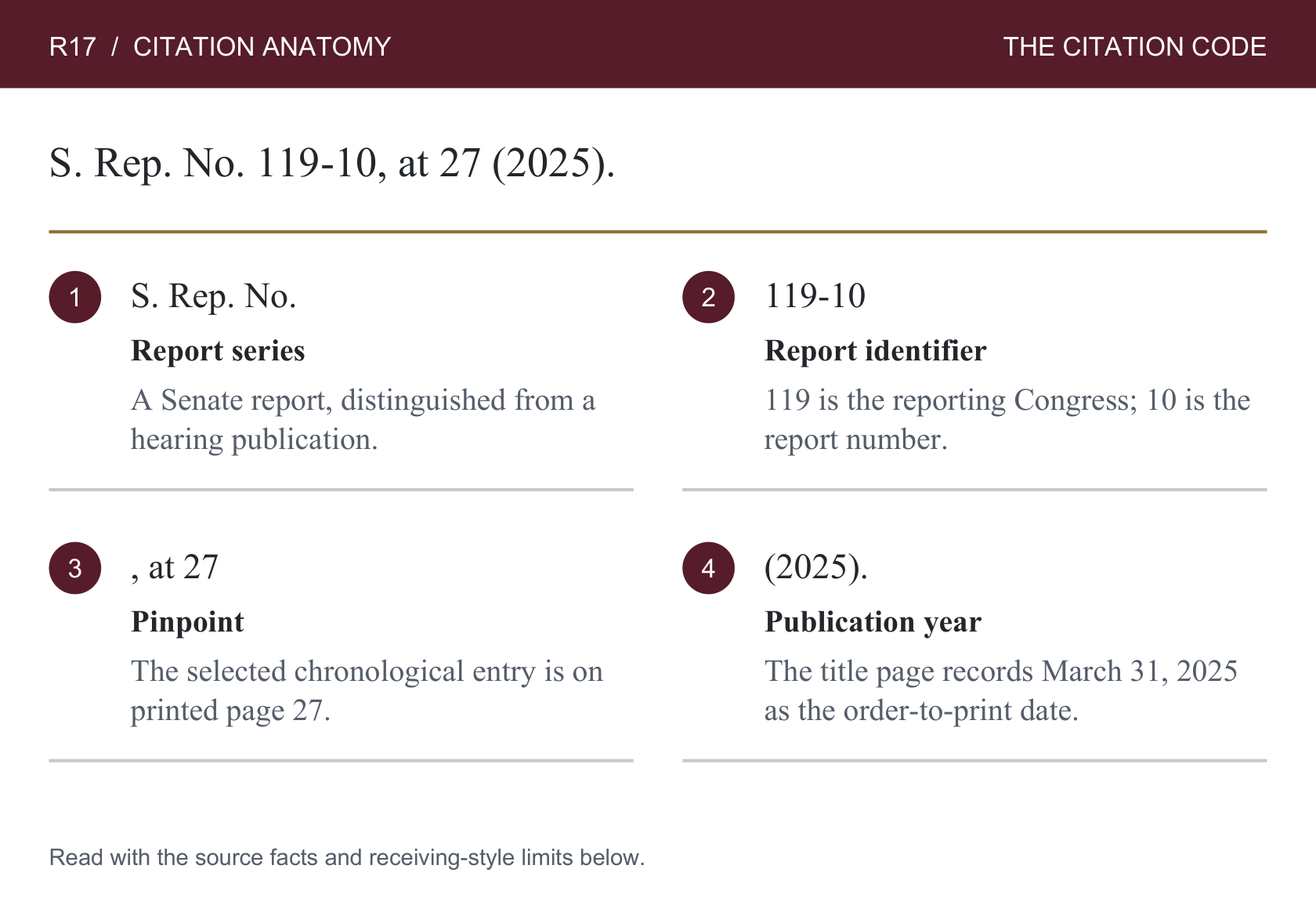
Source packet. Senate Report 119–10 reports on Judiciary Committee activities during the 118th Congress. It was ordered printed in the 119th Congress on March 31, 2025. Printed page 27 lists the May 16, 2023 artificial-intelligence hearing and its hearing-publication number.
| Label | Citation component | Function |
|---|---|---|
| 1. Report series | S. Rep. No. | A Senate report, distinguished from a hearing publication. |
| 2. Report identifier | 119-10 | 119 is the reporting Congress; 10 is the report number. |
| 3. Pinpoint | , at 27 | The selected chronological entry is on printed page 27. |
| 4. Publication year | (2025). | The title page records March 31, 2025 as the order-to-print date. |
The reference contains two legitimate congressional periods, with different roles. Changing 119-10 to 118-10 to match the title's covered period would create a different report identity. The selected page is useful for a modest proposition: the committee's report lists a particular hearing among its activities. It does not reproduce all testimony or convert a witness statement into the committee's findings. R16 supplies the actual hearing source for a claim about the recorded statement. Choosing between these records depends on the proposition, not on which citation looks shorter.
Punctuation and type. The abbreviated report-series title and at before the pinpoint are house conventions. The report number and publication year are source facts. A full descriptive title can be added when it helps distinguish an unfamiliar report for the reader.
Where the locator leads. 27 is the printed report page at PDF index 34. The front matter accounts for the difference between the printed coordinate and the file position.
Receiving-style check. Some recipients request a full report title, committee name, or session designation. Preserve the issuing Congress in the report number when adding those details.
Variation. For the witness's actual words, cite the hearing record after inspecting the relevant statement. For the committee's activity chronology, this report is the directly relevant source.
Inspection and limits. Title page; printed page 27, PDF index 34, entry dated May 16, 2023. Official title page, report number, publication timing, and the selected page-27 entry checked. No inference about enacted policy, committee adoption of testimony, or current legislative status is made.
Official sources, checked October 8, 2026: Report on the Activities of the Committee on the Judiciary, United States Senate, During the One Hundred Eighteenth Congress.
R18 — A government technical report can have both a series number and a DOI
Completed citation: National Institute of Standards and Technology, Artificial Intelligence Risk Management Framework (AI RMF 1.0), NIST AI 100-1, at 1 (Jan. 2023), https://doi.org/10.6028/NIST.AI.100-1.
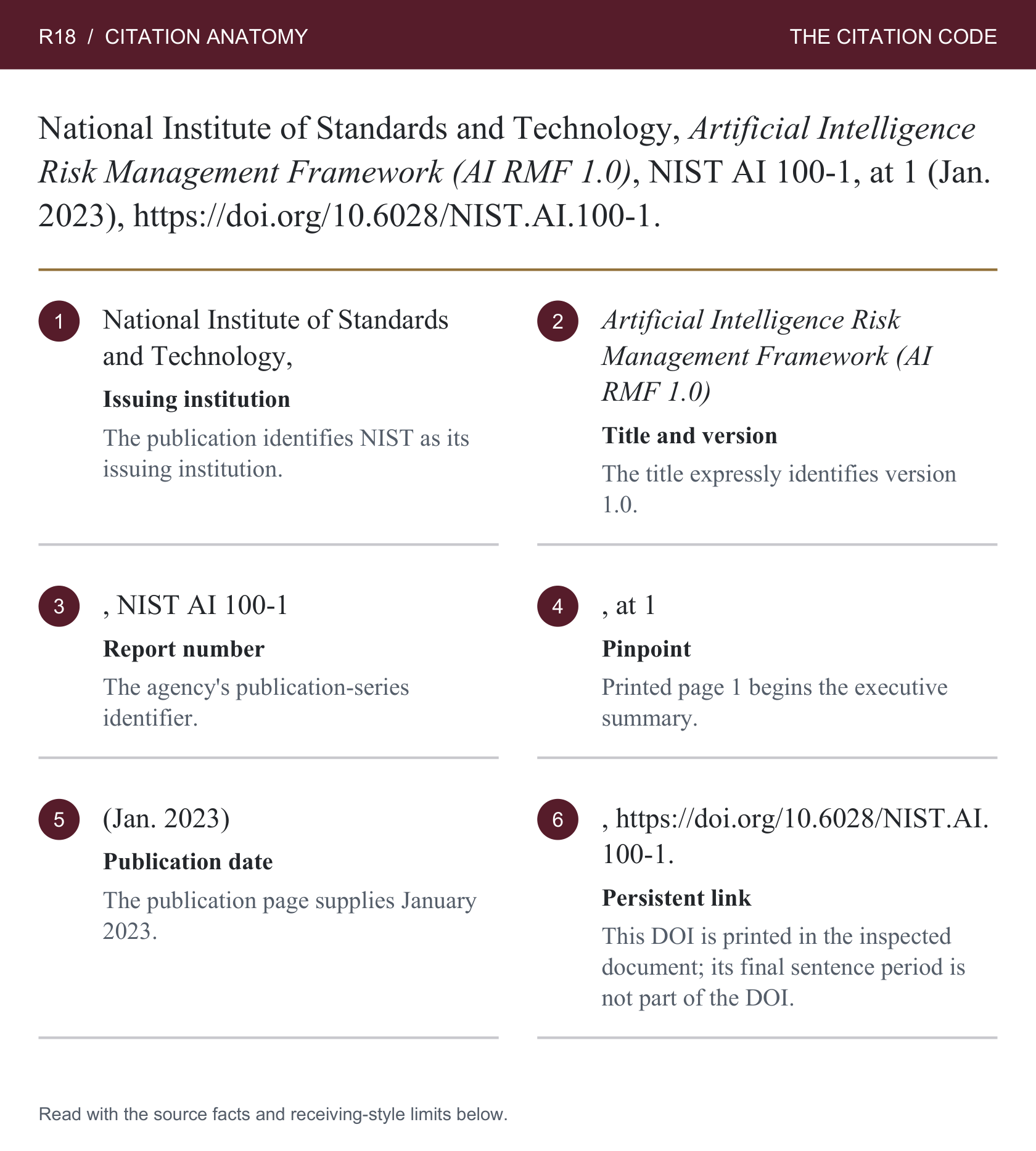
Source packet. The title and publication pages identify NIST AI 100-1, AI RMF 1.0, January 2023, and the displayed DOI. Printed page 1 begins the Executive Summary and discusses AI systems and risks. The publication is a technical framework issued by a government institution.
| Label | Citation component | Function |
|---|---|---|
| 1. Issuing institution | National Institute of Standards and Technology, | The publication identifies NIST as its issuing institution. |
| 2. Title and version | Artificial Intelligence Risk Management Framework (AI RMF 1.0) | The title expressly identifies version 1.0. |
| 3. Report number | , NIST AI 100-1 | The agency's publication-series identifier. |
| 4. Pinpoint | , at 1 | Printed page 1 begins the executive summary. |
| 5. Publication date | (Jan. 2023) | The publication page supplies January 2023. |
| 6. Persistent link | , https://doi.org/10.6028/NIST.AI.100-1. | This DOI is printed in the inspected document; its final sentence period is not part of the DOI. |
Government authorship is a source role, not an automatic legal-status label. Cite this publication as the framework actually consulted. If a writer claims that another authority incorporates or requires part of it, the incorporating authority needs its own inspection and citation. Here both the series number and DOI help retrieval, while the version in the title identifies the work more precisely than a generic reference to NIST guidance. The publication page's officials are not automatically treated as the personal authors of every paragraph merely because their offices appear on the title matter.
Punctuation and type. The title is italicized in this house form; the institutional name and series number remain ordinary type. The DOI is reproduced as a resolvable URL because the source prints that identifier. The comma and terminal punctuation are editorial presentation.
Where the locator leads. At 1 means printed page 1, located at PDF index 5 after covers and front matter. The DOI retrieves the work; it does not by itself retrieve that page.
Receiving-style check. Some recipients prefer a personal author, a shortened agency name, a report-series-first form, or a URL without a DOI prefix. Preserve the version and inspected pinpoint.
Variation. R20 narrows the same report to a numbered figure. Keeping the report identity stable while changing the pinpoint makes the difference between work retrieval and item retrieval visible.
Inspection and limits. Title/publication pages; printed page 1, PDF index 5. Publication identity, printed DOI, date, and selected executive-summary page checked. No claim of current latest version, legal incorporation, or independent validation of the framework's recommendations is supplied.
Official sources, checked October 8, 2026: Artificial Intelligence Risk Management Framework (AI RMF 1.0), NIST AI 100-1.
R19 — The report number does not identify the report page
Completed citation: U.S. Government Accountability Office, Artificial Intelligence: Generative AI Use and Management at Federal Agencies, GAO-25-107653, at 1 (July 29, 2025).
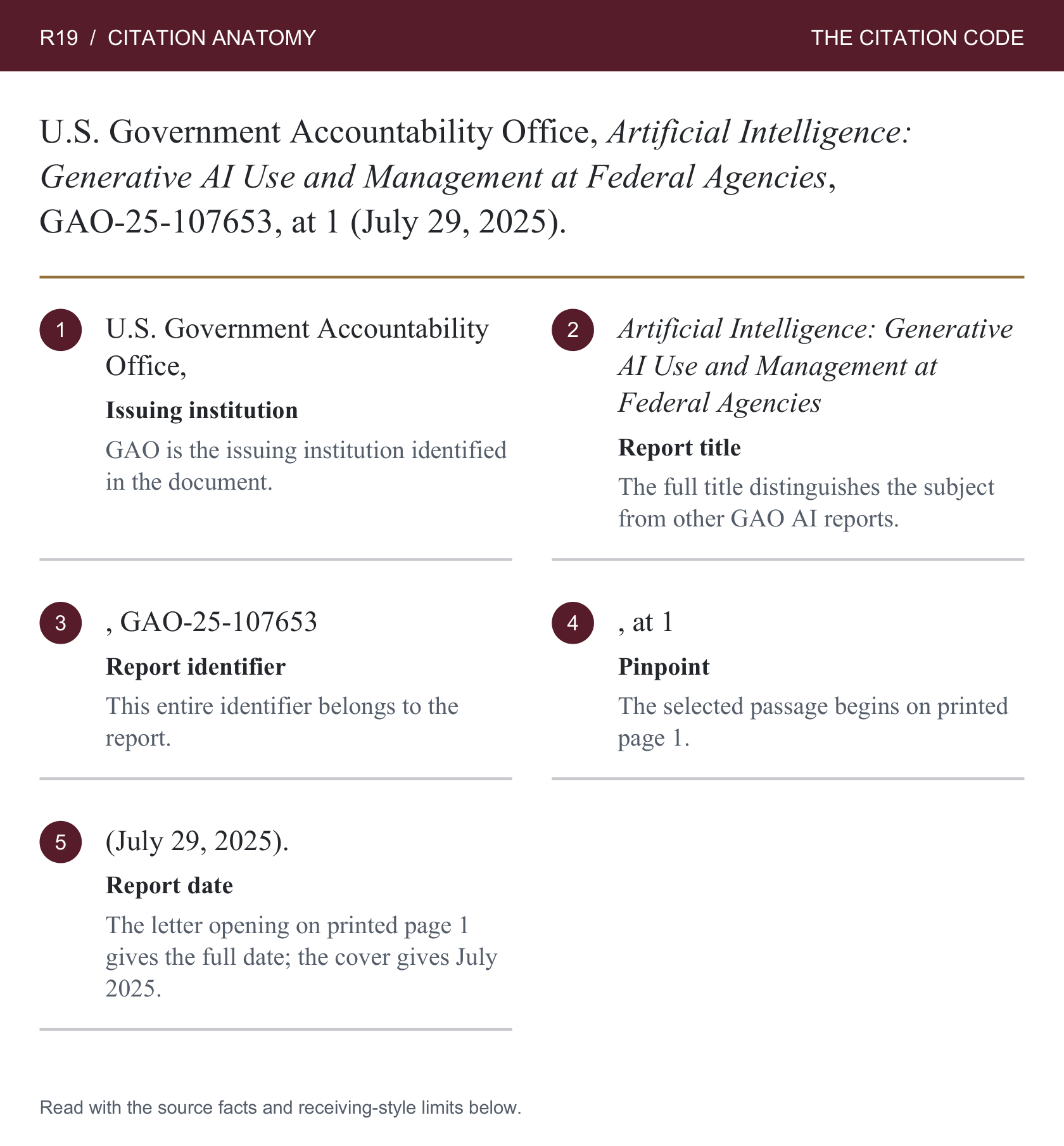
Source packet. The cover identifies a report to congressional requesters, July 2025, numbered GAO-25-107653. Its opening letter is dated July 29, 2025. Printed page 1 introduces generative AI use, opportunities, and risks. The PDF includes cover, highlights, and front matter before that page.
| Label | Citation component | Function |
|---|---|---|
| 1. Issuing institution | U.S. Government Accountability Office, | GAO is the issuing institution identified in the document. |
| 2. Report title | Artificial Intelligence: Generative AI Use and Management at Federal Agencies | The full title distinguishes the subject from other GAO AI reports. |
| 3. Report identifier | , GAO-25-107653 | This entire identifier belongs to the report. |
| 4. Pinpoint | , at 1 | The selected passage begins on printed page 1. |
| 5. Report date | (July 29, 2025). | The letter opening on printed page 1 gives the full date; the cover gives July 2025. |
Numbers within a report identifier are not interchangeable with page numbers or publication dates. Retain GAO-25-107653 as a complete unit. Use the separately verified date and printed-page locator for their own jobs. Also identify whose statement the reader is being asked to evaluate: GAO may present its own analysis, summarize an agency response, or describe another cited source. A quotation from a reproduced agency letter would require attribution to that letter's author and its actual appendix location, not blanket attribution to GAO.
Punctuation and type. The institutional abbreviation and title italics are Citation Code house choices. The hyphenated report identifier comes from the source. At separates the pinpoint from the much longer identifier so a reader can tell where the retrieval address ends and the selected location begins.
Where the locator leads. Printed page 1 appears at PDF index 4. An unnumbered highlights page is a separate part of the file and should be described as such when it is the intended source.
Receiving-style check. A receiving publication may use GAO as an acronym after its first definition or prefer month/year. Use the full date only when it is verified in the actual document.
Variation. For a proposition drawn solely from the highlights, identify the unnumbered Highlights page rather than assigning it the first numbered body page. Inspect the highlights text before quoting it.
Inspection and limits. Cover and printed page 1, PDF indices 0 and 4. The cover identity and dated first report page were checked. The underlying agency datasets, methodology, later developments, and substantive estimates were not independently audited.
Official sources, checked October 8, 2026: Artificial Intelligence: Generative AI Use and Management at Federal Agencies, GAO-25-107653.
R20 — A figure locator identifies an item within a page
Completed citation: National Institute of Standards and Technology, Artificial Intelligence Risk Management Framework (AI RMF 1.0), NIST AI 100-1, at 20 fig. 5 (Jan. 2023).
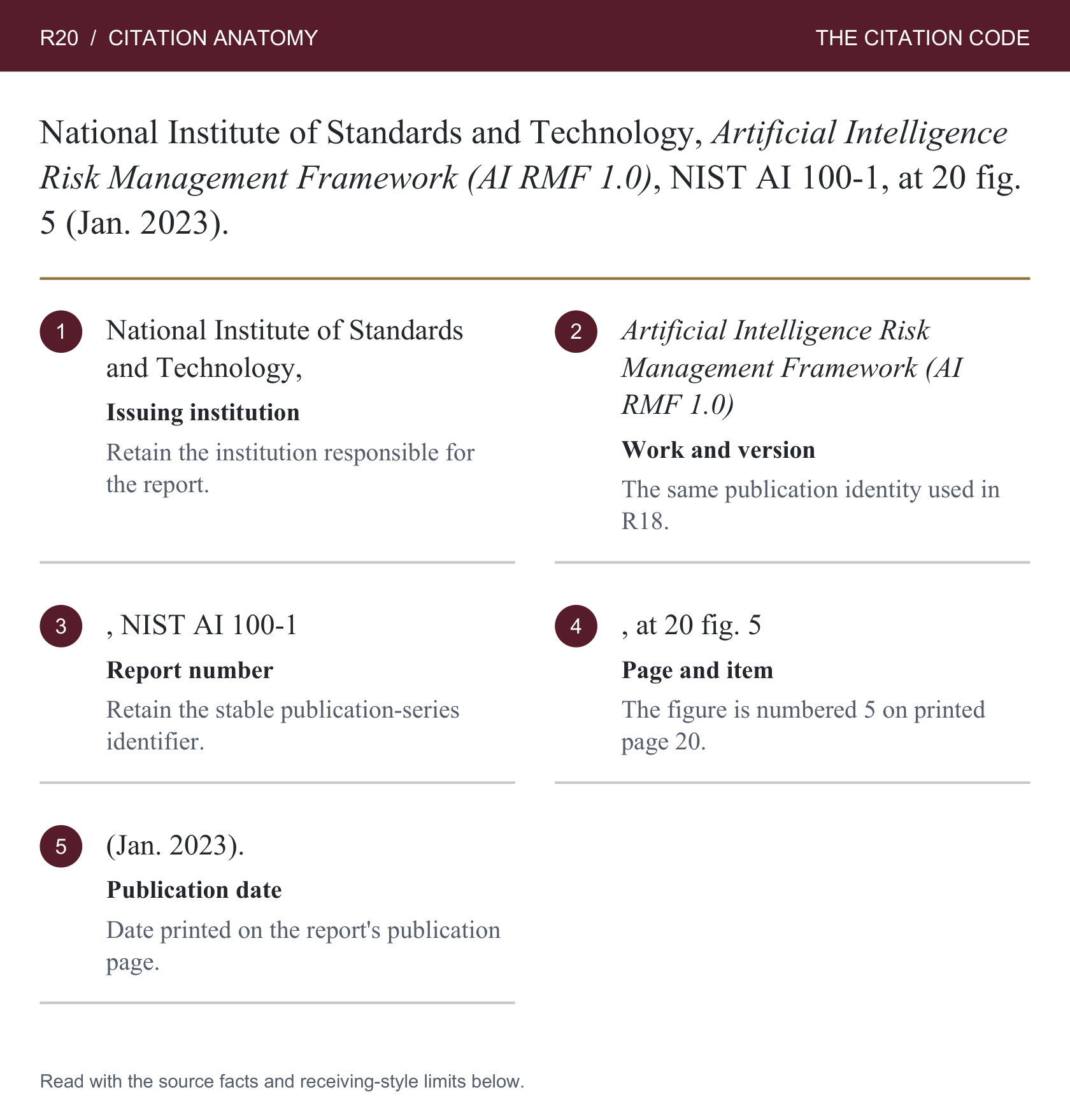
Source packet. Printed page 20 begins the report's Core discussion. Its text and figure 5 caption identify the govern, map, measure, and manage functions. The list of figures also assigns figure 5 to page 20. The inspected PDF text places that page at index 24.
| Label | Citation component | Function |
|---|---|---|
| 1. Issuing institution | National Institute of Standards and Technology, | Retain the institution responsible for the report. |
| 2. Work and version | Artificial Intelligence Risk Management Framework (AI RMF 1.0) | The same publication identity used in R18. |
| 3. Report number | , NIST AI 100-1 | Retain the stable publication-series identifier. |
| 4. Page and item | , at 20 fig. 5 | The figure is numbered 5 on printed page 20. |
| 5. Publication date | (Jan. 2023). | Date printed on the report's publication page. |
A page pinpoint can still leave the intended item unclear when a page contains both prose and a diagram. Adding fig. 5 selects the numbered visual object. This citation identifies the item; it does not claim that Citation Code reproduced it, visually checked every detail, or secured permission for a modified graphic. A newly drawn teaching diagram should state whether it is an independent explanation or an adaptation, and should preserve any necessary attribution. The anatomy diagram accompanying this example should illustrate the citation's own components rather than recreate NIST's graphic.
Punctuation and type. Fig. is a house abbreviation for figure, and the ordering 20 fig. 5 is a house locator convention. Both the page number and figure number are source facts. They must remain separate: figure 20 on page 5 would be a different retrieval request.
Where the locator leads. The locator reaches figure 5 on printed page 20. Verification here covers the figure's number, caption, accompanying text, and page label in the official PDF's extracted text, not the geometry of its artwork.
Receiving-style check. A receiving style may prefer figure before page, a chapter/figure number, or a descriptive caption. Keep the two coordinates unambiguous.
Variation. If discussing the accompanying prose rather than the figure, use at 20 without fig. 5. This small change tells the reader which object supports the sentence.
Inspection and limits. Printed page 20, PDF index 24, section 5 opening and figure 5 caption; list of figures on printed page ii. The report identity, list-of-figures mapping, body caption, page label, and adjacent text were checked. No visual-fidelity analysis, source-image extraction, adaptation, or image-rights clearance was performed.
Official sources, checked October 8, 2026: Artificial Intelligence Risk Management Framework (AI RMF 1.0), NIST AI 100-1.
Editor's final return-to-source check
Before using a worked citation in a new proposition, reopen the exact source version and relocate the passage. Confirm the author or institutional role; read the lead-in and any qualification; then adapt the house form to the receiving requirements. A shortened title or changed typeface can leave source identity intact. A changed number, version, role, or pinpoint can change the source entirely.
The evidence register records official URLs and the selected passages inspected. It does not retain a binary archive or claim file hashes, image-fidelity review, subsequent-treatment review, or independent legal approval. The hearing example specifically distinguishes its official contents-based printed-page mapping from a separately inspected PDF image. Figure 5 is cited through its verified caption and page text; no source artwork was extracted.